
Architect conversion rates are one of the most powerful — and most overlooked — metrics in running a successful architecture firm.
Here's a quick answer if that's what you need:
| Metric | Typical Range |
|---|---|
| Proposal win rate (A&E firms average) | 37–44% |
| High-performing firm target | 50–60% |
| Architecture website conversion rate | ~3.9% |
| Website visitors who return without contact capture | ~1% |
Improving your proposal win rate from 30% to 50% can reduce wasted overhead by 29% — that's a significant boost to profitability without winning a single extra project.
Most firms focus on getting more leads. But the smarter move is converting the ones you already have. Whether that's turning website visitors into inquiries, or proposals into signed contracts, every percentage point matters.
Consider this: one small architecture firm presented 73 proposals in a single year and still only converted 27% of them. More volume didn't solve the problem — better strategy did.
This guide walks you through exactly how to measure, benchmark, and improve every stage of your client conversion process — from your website to your fee proposals.
I'm Rebecca Falzano, Creative Director with nearly 15 years of experience crafting stories and strategies for design-driven businesses — experience that directly informs how I think about architect conversion rates and the messaging that moves clients from curious to committed. Let's dig into the strategies that will help your firm stop leaving projects on the table.
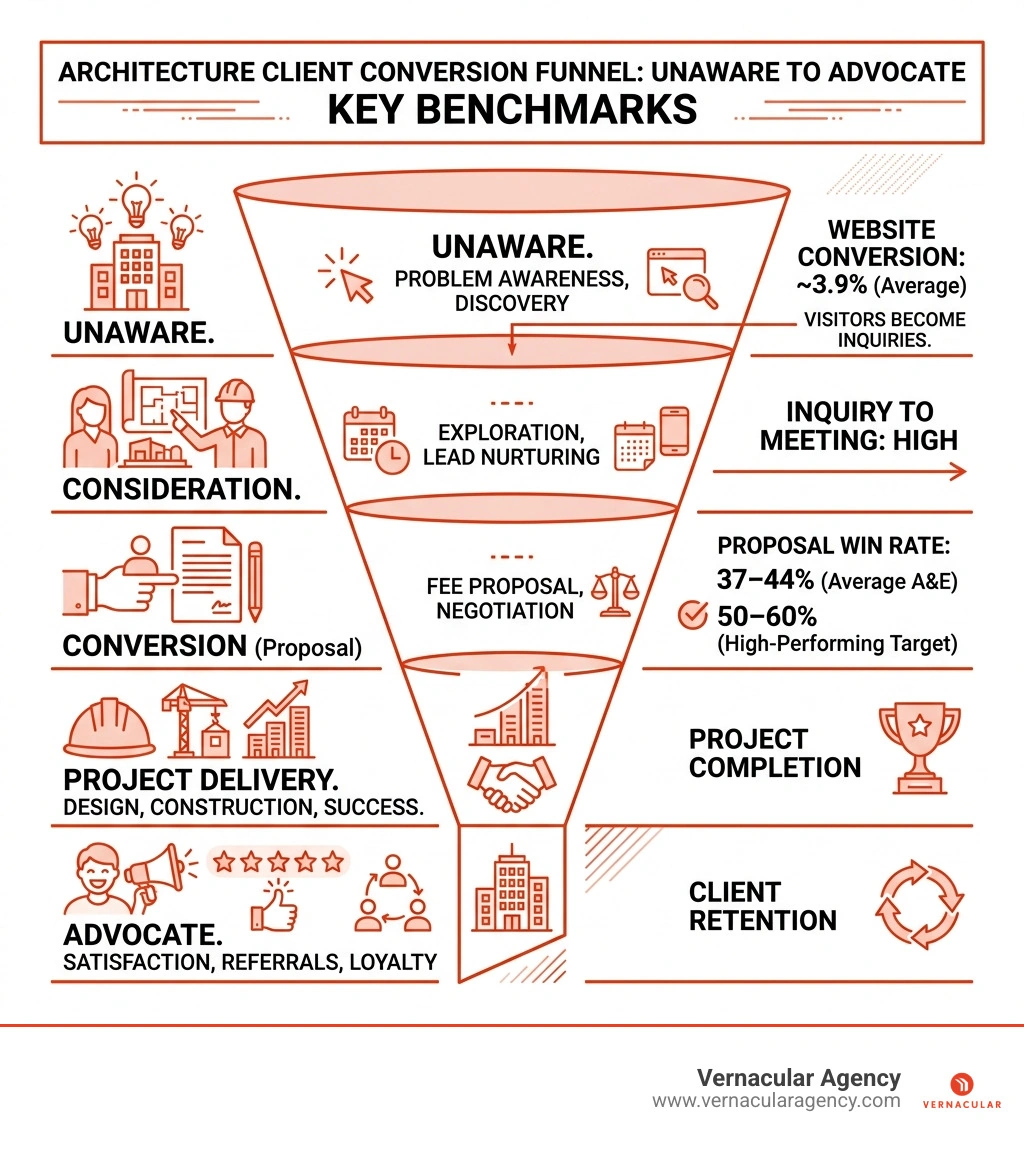
Terms related to architect conversion rates:

In the context of an architecture firm, a conversion rate isn't just a single number; it is a series of milestones that track a prospect's journey from being a stranger to becoming a loyal advocate. At its simplest, a conversion rate is calculated by taking the number of successful outcomes (like a signed contract or a contact form submission) and dividing it by the total number of opportunities (like proposals sent or website visits).
For example, if your firm sends out 10 fee proposals and 4 of them result in signed contracts, your proposal win rate is 40%. In the digital realm, if your website receives 2,000 visits in a month and 80 people fill out your inquiry form, your website conversion rate is 4%.
Understanding these numbers is the first step toward SEO for Architecture Firms. Without tracking, you are essentially "flying blind," unable to tell if a dip in revenue is due to a lack of leads or a failure to close the leads you already have.
How do you know if your numbers are "good"? Industry data for 2026 shows that average Architecture & Engineering (A&E) firms typically win between 37% and 44% of the proposals they pursue. However, high-performing firms—those with disciplined "go/no-go" processes—often target a 50% to 60% win rate.
The financial incentive for hitting these higher benchmarks is massive. When you raise your win rate from 30% to 50%, you aren't just getting more work; you are achieving a 29% reduction in wasted overhead. Think of the hundreds of hours your senior staff spends on unsuccessful pursuits—that is "unbilled" time that could be spent on profitable design work.
| Metric | Industry Average | High-Performer Target |
|---|---|---|
| Proposal Win Rate | 37–44% | 50% + |
| Website Conversion | 1–3% | 4–5% |
| Repeat Business | ~75% | 85% + |
| Overhead Waste | High | Low (29% reduction) |
Your website is often the first "conversation" a client has with your firm. Research shows that over 80% of AEC (Architecture, Engineering, and Construction) buyers visit a firm’s website before reaching out, even if they were referred by a trusted friend. If your site is just a digital portfolio without clear calls to action, you are losing projects before you even know they exist.
A healthy industry average for an architectural marketing website is approximately 3.9%. To track this accurately, we recommend using Google Analytics 4 (GA4) to set up specific "Events" and "Conversions." You should be tracking:
By segmenting this data by source—seeing whether visitors come from organic search, social media, or direct referrals—you can refine your Lead Generation Guide for Architects to focus on the channels that actually move the needle.
Conversion isn't just about math; it's about human psychology. One of the most effective tools in an architect's arsenal is the Principle of Consistency. This behavioral economics concept states that once a person makes a small commitment, they are much more likely to agree to a larger request later to remain consistent with their previous actions.
We see this in everyday life—67% of gym members continue paying their monthly fees even if they stop going, simply because they want to remain consistent with their public identity as a "healthy person." In architecture, we can use this to build trust gradually rather than asking for a massive design fee on the first call. This is a core part of a modern Marketing Strategy for Architects.
One of the biggest mistakes architects make is jumping straight from an initial meeting to a full-service fee proposal. This creates high friction. Instead, consider offering "low-stakes" entry points.
Pre-design services—such as master planning studies, feasibility reports, or paid site consultations—act as small commitments. Once a client has paid you $2,500 for a feasibility study, the "Principle of Consistency" kicks in. They have already "hired" you. When it comes time for the full $50,000 design contract, they are significantly more likely to sign with you than to start over with a stranger.
Digital micro-conversions are the "postcards" of the internet. A famous study showed that asking homeowners to place a small "Drive Safely" postcard in their window increased their willingness to later install a large, ugly lawn sign by 400%.
On your website, you can achieve this by offering:
Only 1% of website traffic typically returns within three months if you don't capture their contact information. By securing these small "yeses," you dramatically improve your Lead Generation for Architects efforts.
Business development for architects is a cycle, not a linear funnel. We like to think of it as a "Conversion Engine" with four distinct gears that must all be turning in sync:
For a deep dive into this lifecycle, check out our Architect Marketing Complete Guide.
When a prospect lands on your site, you are the "Choice Architect." Choice architecture refers to the practice of influencing decisions by how options are presented.
To optimize your site for higher architect conversion rates, consider these UX (User Experience) improvements:
As we move through April 2026, the economic landscape for architects in Maine and across the USA has shifted. While the median annual wage for architects remains strong at approximately $96,690, the AIA Maine reports that firm billings have continued to tighten.
In a tightening market, your architect conversion rates become even more critical. When there are fewer projects to go around, you cannot afford to lose a "perfect fit" client because your website was slow or your proposal was confusing. This is the ideal time to invest in a specialized SEO Agency for Architects to ensure you are capturing the high-intent traffic that is still looking to build.
To move your win rate toward that 50% target, you need a disciplined approach to business development.
The Go/No-Go FrameworkNot every lead is a good lead. High-performing firms use a scoring system to decide whether to pursue a project. They ask:
If you score low on these, "No-Go" is the right answer. It's better to spend zero hours on a losing battle than 40 hours on a proposal that has a 10% chance of success. This selectivity is a hallmark of effective Architecture Firm Marketing.
In 2026, a client's journey is rarely a straight line. They might see your project on Instagram, read a blog post three weeks later, and then finally search for your firm name on Google to contact you.
How do you know which channel "converted" them?
For more on technical tracking, see our SEO for Architects Complete Guide.
We often see architects lose projects at the very last yard because of their fee proposals. Avoid these common pitfalls:
While the A&E industry average is between 37% and 44%, we recommend aiming for 50%. If your win rate is 90%, your fees are likely too low. If it's below 20%, you are likely pursuing the wrong types of projects or failing to communicate your value effectively.
In a downturn, the "Prospect-to-Project" ratio often widens. You may find that you need more leads to get the same number of signed contracts because clients are more hesitant. Conversely, in a booming market, your conversion rate might naturally rise, but you must be careful not to take on "bad fit" projects just because they are easy to close.
Most architecture websites function as galleries, not growth engines. If your bounce rate is high, it’s likely because your site takes too long to load, isn't mobile-friendly, or lacks a clear "Next Step" for the visitor. You have about 55 seconds to convey your value before a visitor leaves.
At Vernacular Agency, we believe that architecture is a blend of art and business. By treating your architect conversion rates with the same level of precision you bring to a structural detail, you can transform your firm from a "portfolio gallery" into a high-performance growth engine.
Whether you are based in Portland, Maine, or serving clients across the USA, the goal remains the same: stop wasting overhead on the wrong pursuits and start winning the projects you truly want. Strategic branding, data-driven SEO, and a deep understanding of client psychology are the keys to long-term profitability.
Ready to see how your website measures up? Transform your studio with expert web development and let's start turning your visitors into your best clients.