Why Choosing the Right Architect Firm Matters
An architect firm employs licensed architects to design buildings and spaces, changing your vision into reality. These firms offer a suite of services, including:
- Design Services: Creating plans from concept sketches to detailed construction documents.
- Project Management: Coordinating timelines, budgets, and construction teams.
- Regulatory Navigation: Ensuring designs meet all building codes, zoning laws, and safety requirements.
- Construction Administration: Overseeing building progress to ensure designs are executed correctly.
The right firm is more than a technical service; it's a partner. As the firm SOM describes, they are "a collective of architects, designers, engineers, and planners working together to build a better future." Whether for a home or a commercial development, your architect helps create tangible structures that serve your needs for decades. With some of the oldest active firms in the U.S. founded in 1853, the profession is built on a legacy of quality and strong client relationships.
I'm Rebecca Falzano, Creative Director at Vernacular Agency. With nearly 15 years of experience collaborating with design professionals, I've seen how the right architect firm partnership transforms both built environments and the brands behind them.
Choosing the Right Architect Firm for Your Project
Finding the perfect architect firm is one of the most important decisions you'll make. You're choosing a partner to guide you through challenges, understand your vision, and create a structure that exceeds expectations.

When choosing a firm, consider these key factors:
- Firm Size and Scope: Small firms (<5 people) offer personalized service, while medium firms (5-50) have specialized departments. Large firms like Gensler, with 56 global locations, handle massive, complex projects. Match the firm's size to your project's needs.
- Design Philosophy and Portfolio: Look beyond beautiful photos to understand a firm's values. Does it prioritize innovation, sustainability, or a specific aesthetic? For example, Morphosis Architects is known for "rigorous design and research," while Adrian Smith + Gordon Gill Architecture focuses on "high-performance, energy-efficient and sustainable architecture." Ensure their philosophy aligns with your goals.
- Client Testimonials: Past clients offer the real story on a firm's reliability, communication, and problem-solving skills. These insights are often more valuable than marketing materials.
- Licensure and Structure: In the U.S., an architect firm must employ licensed architects and often be registered itself. This is a non-negotiable requirement ensuring work is supervised by qualified professionals, as detailed in resources like The Architect's Handbook of Professional Practice.
- Awards and Recognition: While not everything, awards indicate peer recognition for excellence. Platforms like Architizer rank firms on metrics like A+Awards won. A firm like Brooks + Scarpa Architects, with "over fifty-five major design awards," has demonstrated consistent quality.
Understanding Firm Specializations
Architect firms often focus on specific building types. Finding a specialist ensures they have relevant experience for your project.
- Residential: Designs homes, from single-family houses (Brooks + Scarpa Architects) to multi-family complexes (MBH Architects).
- Commercial: Covers offices, retail, and hotels, emphasizing brand identity and economic viability (Gensler, MBH Architects).
- Cultural: Includes museums, theaters, and galleries, requiring a deep understanding of visitor experience (Studio Gang, Morphosis Architects).
- Healthcare: Demands specialized knowledge for hospitals, clinics, and labs to prioritize patient well-being and efficiency (MBH Architects).
- Sustainability: Focuses on environmentally responsible buildings using green tech and innovative materials (Adrian Smith + Gordon Gill Architecture, LEVER Architecture).
- Urbanism: Works at a larger scale on master planning and public space design to shape entire communities (SOM, Henning Larsen).
Key Roles Within an Architect Firm
A team of dedicated professionals brings every project to life.
- Principals: The firm's leaders and owners, guiding the overall vision.
- Project Architects: Handle the day-to-day design and technical development.
- Project Managers: Oversee timelines, budgets, and coordination.
- Design Staff: Architectural designers and interns who develop concepts and create renderings.
- Technical Staff: Drafters and BIM specialists who ensure the accuracy of construction documents.
In small firms, individuals may wear multiple hats, while larger firms are often departmentalized. Modern practice thrives on interdisciplinary collaboration, with firms like SOM describing themselves as "a collective of architects, designers, engineers, and planners."
The Collaborative Process: From Blueprint to Building
The journey from idea to finished building is an ongoing, creative collaboration with your architect firm. They act as both guide and translator, turning your vision into a buildable reality while managing the countless moving parts.

Your firm handles project management—coordinating timelines, tracking budgets, and orchestrating specialists like engineers and designers. Clear communication protocols are essential to keep you informed. They also steer the complex web of building codes, zoning laws, and environmental regulations, ensuring your project moves forward smoothly and legally.
The Role of Your Architect Firm in Project Management
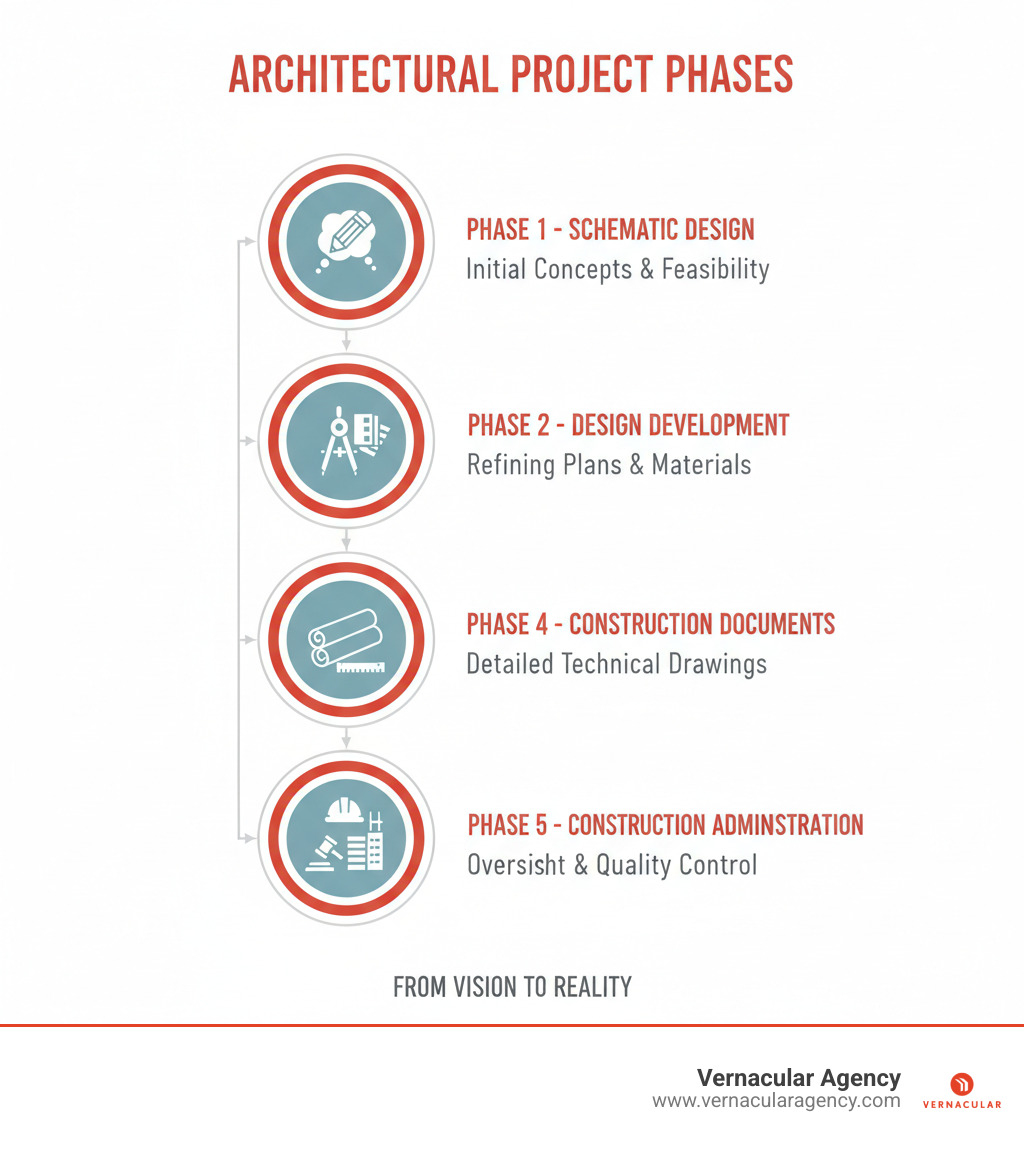
The architectural process is structured in distinct phases, turning ideas into construction-ready plans.
- Initial Consultation & Site Analysis: The architect listens to your goals and studies your property's unique characteristics, like sunlight, views, and topography.
- Schematic Design: Concepts take form through sketches and simple floor plans, exploring different approaches to spark conversation.
- Design Development: The chosen direction is refined. Plans become more detailed, and materials, finishes, and systems are selected.
- Construction Documents: These are the detailed blueprints contractors use to build, specifying everything from foundation depths to paint colors.
- Bidding and Negotiation: Your architect helps you select a qualified contractor by preparing bid packages and evaluating proposals.
- Construction Observation: The architect acts as your advocate on-site, reviewing work to ensure it matches the design intent and quality standards.
Fostering a Successful Client-Architect Relationship
The best projects emerge from genuine partnerships. Success depends on a few key principles.
- Establish Clear Goals: Be honest about your budget, functional needs, and aesthetic dreams from the start. As MBH Architects notes, success is built on "communication, trust, and results."
- Provide Constructive Feedback: If something doesn't feel right, explain why. Your architect is an expert problem-solver who can adjust course with clear input.
- Accept Trust and Transparency: Trust your architect's expertise, and they will trust you to make informed decisions. S^A | Schwartz and Architecture describes guiding "clients through a highly interactive design process."
- Manage Expectations: Understand that design is iterative. Challenges will arise. A good architect firm communicates proactively and works with you to find solutions.
The Evolution of the Modern Architectural Practice
The architect firm of today has evolved from a solitary pursuit into a complex, technology-driven, and globally connected profession. While firms like SmithGroup (1853) in the U.S. and Brierley Groom (1750) in the UK have long legacies, modern practice has been revolutionized.

Technology like Building Information Modeling (BIM) and Virtual Reality (VR) allows for a level of precision and collaboration that was once impossible. Global firms like Gensler, with 56 international locations, leverage this technology to work across diverse cultures and climates. Many now operate as interdisciplinary collectives. SOM (Skidmore, Owings & Merrill) brings together architects, designers, engineers, and planners from day one, leading to more holistic and innovative solutions.
Trends Shaping the Future of Architecture
Leading firms are defining the response to our time's most pressing challenges.
- Sustainability and Resilience: Climate-responsive design is now a necessity. Adrian Smith + Gordon Gill Architecture centers its practice on high-performance, sustainable buildings, while Henning Larsen designs solutions like the Hælug flood embankment to address climate resilience directly. The goal of net-zero buildings is becoming a standard.
- Material Innovation: Firms are exploring new materials to reduce environmental impact. LEVER Architecture is a pioneer in Cross-Laminated Timber (CLT), a sustainable alternative to concrete and steel. Henning Larsen is designing with bio-based materials like straw for the BESTSELLER Logistics Center West.
- Prefabrication and Modular Construction: These methods reduce waste and shorten timelines. MBH Architects uses modular construction to expedite affordable housing projects.
- Adaptive Reuse: Reimagining existing structures is a key sustainable practice. Studio Gang's "architectural grafting" brings new life to old buildings, while Gensler champions office-to-residential conversions to revitalize urban cores.
The Firm's Role in Urbanism and City Development
An architect firm's influence extends beyond single buildings to shape entire communities. Through master planning, firms like Henning Larsen design cohesive urban environments. They also create vital public spaces—parks, plazas, and civic hubs—that foster connection. The best firms practice community engagement, listening to the people who will use their designs to create more equitable and meaningful places, a philosophy embodied by Studio Gang's "Actionable Idealism." Firms address critical urban challenges, from housing affordability (MBH Architects) to coastal resiliency (BIG), creating thriving cities for future generations.
Frequently Asked Questions about Hiring an Architect
Hiring an architect firm can feel unfamiliar, so it's natural to have questions. Here are answers to some of the most common concerns.
How are architectural fees typically structured?
Architectural fees are not one-size-fits-all. Common structures include:
- Percentage of construction cost: The fee is a percentage of the final construction cost. The rate often varies based on project complexity.
- Fixed fee: A lump-sum amount agreed upon upfront. This works well for projects with a clearly defined scope and offers budget predictability.
- Hourly rate: You pay for the actual time the architectural team spends on your project. This is ideal for projects with an undefined scope or for initial consultations.
- Hybrid models: Many firms blend these approaches, such as a fixed fee for design and an hourly rate for construction administration.
Discuss fees early and ensure the structure is clearly defined in your contract.
What should I prepare for my first meeting with an architect?
A productive first meeting starts with good preparation. Bring the following:
- Project Goals: Think about what you want to achieve and what problems you're trying to solve. This can be as simple as "I want more natural light."
- A Realistic Budget: Have a ballpark figure in mind. This helps the architect design within your financial reality.
- Inspirational Images: Collect photos from magazines or Pinterest that show spaces, materials, or styles you like (and dislike). This visual language is incredibly helpful.
- Site Information: If you have a property, bring any surveys, deeds, or photos you have.
- A List of Questions: Ask about their process, experience, and anything else on your mind. A good architect welcomes questions.
What is the difference between an architect and a contractor?
Understanding this distinction is key to a smooth project.
Your architect firm is the designer. They translate your vision into a functional, beautiful, and code-compliant building. They create the concept, produce detailed drawings, solve spatial problems, and act as your advocate throughout the process.
The contractor is the builder. They take the architect's plans and make them a physical reality. They manage the construction site, coordinate subcontractors (plumbers, electricians), order materials, and ensure the building is constructed safely and according to the plans.
In short, the architect designs your dream; the contractor builds it. They work together, but their roles are distinct and complementary.
Conclusion: Building Your Future and Your Firm's Legacy
Choosing an architect firm is more than hiring a service; it's selecting a partner to make your vision tangible and lasting. These firms blend creative design, technical expertise, and project management to steer complex regulations, coordinate specialists, and deliver spaces that serve you for generations.
A successful project hinges on the partnership between client and architect. When communication, trust, and collaboration are strong, remarkable things happen. The architectural landscape is constantly evolving, with firms pushing the boundaries of sustainability, material innovation, and urban design to create more resilient and equitable communities.
For architecture firms, standing out requires communicating what makes you unique. Your design philosophy, specialized expertise, and commitment to sustainability are the core of your brand story. A strong brand identity and digital presence help you attract the clients who align with your values.
At Vernacular Agency, we understand that the principles of great architecture—clarity, detail, and thoughtful execution—also create great brands. If your firm is ready to showcase what makes you different, we'd love to help you tell that story.
Learn how strategic branding and a powerful website can elevate your architect firm and build a legacy as enduring as the structures you design.
