
Architect marketing strategies are essential for breaking free from the industry's notorious feast-or-famine cycle. Many talented architects find themselves wondering where their next project will come from, despite delivering exceptional work. The reality is sobering: architects capture only about 5% of residential architecture projects, with the majority going to builders and design companies. Traditional word-of-mouth referrals, while valuable, aren't enough to sustain consistent growth in today's competitive landscape.
Key Architect Marketing Strategies:
The good news? A well-executed marketing strategy can transform your practice. It builds trust before the first conversation, shortens sales cycles, attracts better-fit clients, and allows you to command higher-value projects. The challenge isn't your design skills—it's getting in front of the right clients at the right time.
I'm Rebecca Falzano, and with nearly 15 years of experience as a shelter magazine editor and writer, I've seen how compelling storytelling and strategic content creation drive results for design professionals. Throughout this guide, I'll share proven architect marketing strategies that help firms like yours move from reactive referrals to proactive, predictable client acquisition.
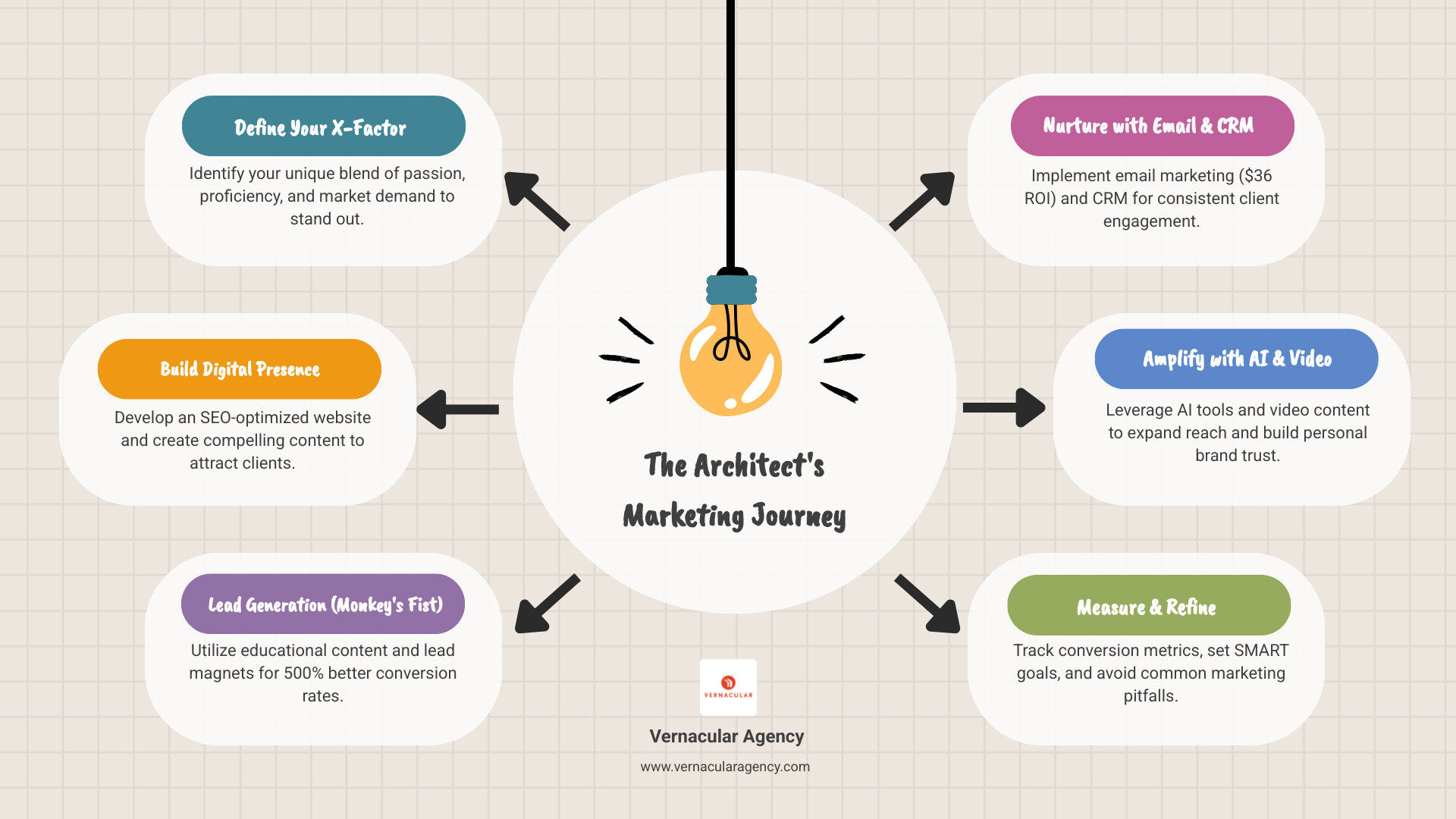
Designing a marketing strategy for your architecture firm is a lot like designing a building project. It requires a clear vision, a detailed plan, a budget, and a focus on measurable results. Effective marketing is the process of making prospects aware of the value your design firm provides and persuading them to take the next step in your process.
A common pitfall is that most architecture firm marketing targets only the small percentage of clients who are ready to hire immediately. But only about 3% of potential clients are ready to engage an architecture firm at any one time. The vast majority—a whopping 91%—are in the information-gathering stage.

Understanding this "Client Demand Pyramid" is fundamental. If you're only speaking to the 3%, you're missing out on building relationships with the 91% who will eventually need your services. Our goal with effective architect marketing strategies is to build prominence, recognition, and relationships in the market long before a direct sales pitch is appropriate. To dig deeper into how these foundational concepts apply, explore our guide on Architecture and Marketing.
Beyond understanding your audience, embracing agile marketing principles can be a game-changer. This approach involves creating a minimum viable version of a marketing campaign, launching it to get feedback, analyzing the results, and then making adjustments. It's an iterative process that allows for flexibility and responsiveness to market demands.
To truly stand out, you need to identify your firm's unique "X-factor"—that one thing that sets you apart. As marketing strategist Nikita Morell puts it, your X-factor sits at the intersection of your passion, your proficiency, and market demand.
For example, perhaps your passion lies in crafting sustainable, net-zero homes that blend seamlessly with Maine's rugged coastal environment. Your proficiency might be in innovative timber-frame construction or passive house design. And the demand? A growing number of environmentally conscious homeowners seeking energy-efficient, resilient homes.
Niching down is not about limiting your potential; it's about focusing your energy to attract high-value clients who specifically seek your unique expertise. Whether it's historical preservation, modern lake houses, or robust coastal homes, defining your niche allows us to craft targeted architect marketing strategies that resonate. Find more about Finding your X-factor and how it can differentiate your practice.
Once you've identified your firm's X-factor, the next step is to attract those ideal clients, especially the 91% still in the information-gathering phase. This is where the "Monkey's Fist" strategy comes in—a powerful analogy for lead generation that can return results 500% greater than traditional marketing efforts.
In marketing, your "Monkey's Fist" is valuable, educational content offered for free. This content addresses your potential clients' questions, concerns, and aspirations related to architectural projects, building trust and familiarity long before they are ready to hire. For architects in Maine, this could be a guide titled "Designing Your Dream Coastal Home in Maine" or "A Homeowner's Guide to Sustainable Living in New England."
The results speak for themselves: one architect using this strategy generated 75 leads in the first month by offering educational content via an industry blog. Another saw over 140 leads in one weekend at a trade show by distributing a specialized booklet. By focusing on educating, not just selling, you build a relationship based on trust. This approach is central to effective Lead Generation for Architects.
Your firm's online presence is your most powerful asset. With 91% of potential clients gathering facts online before hiring an architect, a high-performance digital presence is non-negotiable for robust architect marketing strategies.
An optimized website needs to be visually stunning, showcasing your best projects with rich photography. But beauty isn't enough; functionality is paramount. Follow the "3-click rule," meaning users should be able to access any page within three clicks from your homepage. Your website must also be mobile-friendly, as search engines prioritize responsive designs. Page speed is another critical factor—we use tools like Google PageSpeed Insights to ensure your site loads quickly. For comprehensive guidance, check out our insights on Website Design for Architects.
A beautiful website is only effective if people can find it. SEO is about making your website visible to search engines like Google, which handles over 93% of online searches. For architects in Maine, this means optimizing your site so that when a potential client searches for "coastal home architect Maine," your firm appears prominently.
Our approach begins with thorough keyword research, focusing on "long-tail keywords"—more specific phrases that attract highly qualified leads with a stronger intent to hire. We integrate these naturally into your website's content, titles, headings, and image alt text. We also publish compelling blog posts, detailed case studies, and informative articles that establish your firm as an authority.
Content marketing is incredibly effective, with 96% of marketing decision-makers reporting its success. We also focus on building high-quality backlinks from reputable websites, which signals to Google that your site is a credible source. To master your firm's online visibility, refer to our SEO for Architects Complete Guide.
Email marketing remains one of the most powerful and cost-effective architect marketing strategies. For every $1 spent on email marketing, there's an average return of $36 to $42. It allows for a direct, personalized conversation with your audience, bypassing social media algorithms.
Building an email list is key, often achieved by offering a valuable lead magnet in exchange for an email address. Automation tools can streamline your efforts—we set up automated welcome sequences, follow-up emails, and nurturing campaigns that deliver relevant content at the right time.
Customer Relationship Management (CRM) software becomes invaluable here, allowing you to manage client contacts, track interactions, and segment your audience. By integrating CRM with your email marketing, you can send personalized messages and ensure no lead falls through the cracks. Learn more in our Email Marketing for Architects Guide and see how our CRM Solutions can streamline your efforts.
The digital landscape is constantly evolving, and two powerful tools for modern architect marketing strategies are Artificial Intelligence (AI) and video content. Embracing these technologies can significantly amplify your firm's reach, build personal brand trust, and generate innovative ideas.
AI is rapidly changing the game, not just in design but in marketing. It can be a powerful assistant for architects, helping to research audiences, generate content ideas, and even draft initial marketing copy. For example, using a tool like ChatGPT, you can provide prompts such as: "As a residential architect specializing in modern waterfront homes in Southern Maine, generate 10 blog post ideas addressing common challenges and design solutions for clients." AI can also help repurpose existing blog content into short-form social media posts, maximizing your content's reach. While AI is a fantastic tool for brainstorming and efficiency, we always emphasize a human editing step to ensure authenticity and accuracy.
Video content is equally powerful in its ability to engage and build relationships. Videos receive 1200% more shares than text and image content combined, making them ideal for showcasing your architectural firm's portfolio and personality. People prefer to work with people, and video helps humanize your firm, putting a face to your brand.
You don't need a Hollywood budget to create impactful video content. Simple iPhone videos featuring you or your team discussing client challenges, walking through a project site, or sharing design inspiration can be incredibly effective. Live videos on platforms like Facebook receive six times more engagement than regular videos. Use video to tell your firm's story, showcase your value, and build trust with potential clients before they're ready to hire.
Even the most brilliant architect marketing strategies are only effective if you can measure their success and adapt your approach. This means moving beyond "vanity metrics" to focus on what truly drives business growth.
| Metric Type | Vanity Metrics (What they look like) | Conversion Metrics (What they look like) |
|---|---|---|
| Website | Page views, bounce rate | Lead form submissions, consultation requests |
| Social Media | Likes, followers, shares | Website clicks, direct messages (project inquiries) |
| Open rate | Click-through rate to lead magnet, booked meetings | |
| Content | Blog comments, time on page | Lead magnet downloads, contact form fills |
Tools like Google Analytics are indispensable for tracking which pages bring in visitors, how long they stay, and what actions they take. For SEO efforts, SEMrush can show if your strategies are paying off in search rankings. Monitoring email open and click-through rates, as well as social media engagement, provides valuable insights to tweak your approach.
Crucially, we define clear, measurable goals from the outset. We use the SMART framework: Specific, Measurable, Achievable, Relevant, and Time-bound. For instance, instead of "get more clients," a SMART goal would be "increase qualified inbound leads by 20% within the next six months through SEO and content marketing." This allows us to track progress and adjust strategies as needed. For more on planning your firm's growth, refer to our Marketing Strategy for Architects.
However, even with a solid plan, architects can fall into common marketing pitfalls:
By setting clear goals, consistently measuring performance, and avoiding these common traps, your architecture firm can build a sustainable, client-generating marketing machine.
The "feast or famine" cycle often stems from a reactive approach to marketing. To break free, we advocate for a proactive, consistent, and systematic approach to your architect marketing strategies. The key is to always be building your lead pipeline through strategies like the "Monkey's Fist," consistent SEO and content marketing, and ongoing email nurturing. By targeting the 91% of clients in the information-gathering stage, you ensure a steady stream of qualified leads, allowing you to maintain a more consistent workflow.
There isn't a single "best" social media platform; the most effective choice depends on your target audience. However, certain platforms stand out:
The best strategy is to choose one or two platforms where your ideal clients spend most of their time and focus your efforts there with consistent, valuable content.
Marketing is the overarching strategy encompassing all activities involved in promoting your services, building your brand, and generating leads. It includes market research, defining your target audience, content creation, and much more.
Advertising is a specific tactic within marketing—the paid placement of messages in media to promote a product or service, such as digital ads on social media or search engine ads.
Historically, architects faced professional sanctions for advertising, leading to a culture where direct promotion felt uncomfortable. While these restrictions were abolished in 1972, many firms still rely heavily on referrals. In today's competitive environment, a holistic marketing strategy that strategically incorporates advertising is essential. Marketing builds the foundation of trust and awareness; advertising can then amplify your message to reach a broader audience.
Designing a winning marketing strategy for your architecture firm is an investment in your future. It's about consciously shaping your firm's narrative, connecting with your ideal clients in meaningful ways, and ensuring a predictable flow of projects that align with your passion and expertise. By implementing the architect marketing strategies we've explored—from defining your X-factor and leveraging the "Monkey's Fist" to building a robust digital presence with SEO, content, email, and embracing AI and video—you can move beyond the feast-or-famine cycle and cultivate sustained growth.
At Vernacular Agency, we specialize in helping architecture firms like yours in Maine and beyond. We offer comprehensive, creative solutions that span brand definition to media placement, custom for local and national markets. Our expertise in crafting dynamic brand identities, advertising, and SEO-optimized websites ensures that your firm's unique vision is not only seen but also resonates with the right audience.
We believe that great design deserves great marketing. Let us help you translate your architectural brilliance into compelling stories and strategic campaigns that attract more clients and allow you to focus on what you do best: designing incredible spaces.
Ready to design a winning future for your firm? Explore our full range of Marketing Services and let's start a conversation about how we can build your success together.
