
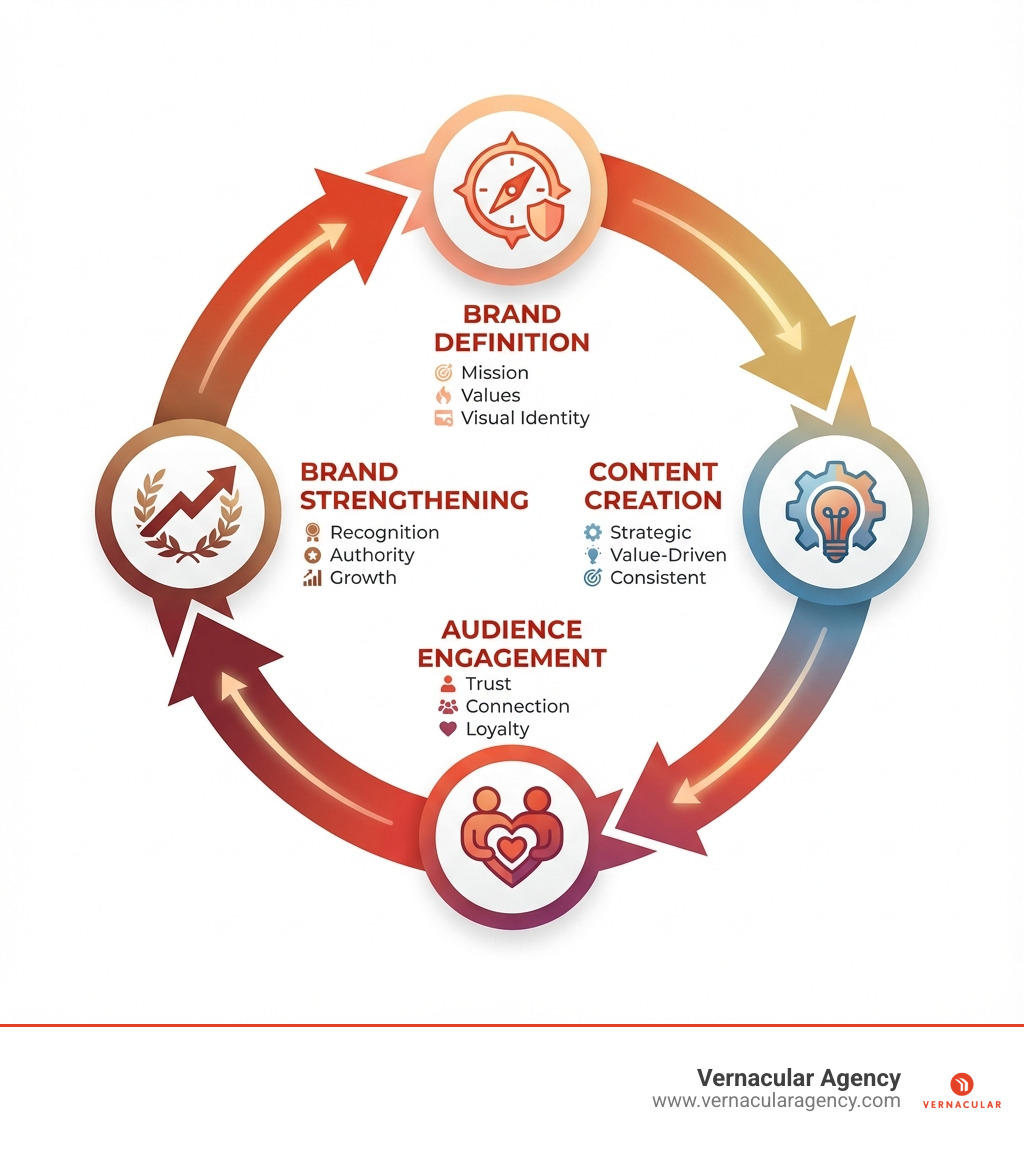
Branding and content creation work together to define who you are and tell your story to the world. Here's what you need to know:
Key Components:
The Process:
Think of your brand as your reputation. It exists whether you shape it intentionally or not. As one instructor noted, "Your brand is not defined by you, it's defined by the way other people perceive you or the way you're thought about in the industry." This makes branding and content creation essential—not optional—for any business that wants control over how customers see them.
The strongest brands share one thing in common: a clear "why." During every interaction with your business, customers should understand why you exist, why you stand out, and why they should choose you. Content creation is how you communicate that "why" consistently across every touchpoint.
But many businesses struggle with inconsistent branding, ineffective messaging, and content that fails to connect. The result? Wasted marketing dollars, confused customers, and missed opportunities. 45% of marketers say increasing brand awareness through content is their top goal—yet many lack a structured approach to achieve it.
I'm Rebecca Falzano, Creative Director at Vernacular Agency, and I've spent nearly 15 years guiding the journey of branding and content creation for publications and businesses—from initial spark to final product. I've learned that successful brands aren't built on luck; they're built on strategic foundations and compelling stories that resonate with the right audience.
Before we can create content that truly sings, we need to know what song we're singing. Your brand identity is the soul of your business—it's who you are, what you stand for, and how you want the world to perceive you. It's much more than just a logo; it's a holistic approach to reputation management. As one expert puts it, branding is "a journey and a promise you’re committed to keeping to a specific set of people with a shared value or goal." It's everything we do to take our specific audience from point A to point B.
Developing a unique personal brand, whether for an individual or a business, that resonates with your target audience involves several key elements. It's about doing the hard work to develop a look and feel that is recognized as your own, with a through line between everything you create.
Who are we building this brand for? This is perhaps the most critical question we can ask. Creating a brand for "everyone" often results in connecting with no one. We must know our target audience deeply and be very specific in our understanding and description of them. This means moving beyond simple demographics to understand their motivations, pain points, and decision criteria.
How do we identify our target audience and tailor our content accordingly? We start by asking key questions:
We can gain these insights by reading industry studies, asking our customer service teams about common issues, and surveying our audience about their buying journey. If we already have a website, we can look into our website analytics to see what search terms drive traffic or which pages get the most engagement. This deep understanding allows us to create detailed buyer personas, ensuring our content speaks directly to their needs and desires.
Once we know who we're talking to, we can define how we talk to them. This is where our brand voice, tone, and personality come into play. Our core messaging should clearly communicate our value proposition and what sets us apart.
How do we define our brand voice and messaging? We consider:
A brand's voice should align with its values and visuals. Some brands are confident and authoritative, while others are warm and welcoming, or even funny and clever. The goal is to ensure our messaging is clear and consistent across all communications, from ads to resource guides. This consistent voice builds familiarity and trust, helping us find our "brand's center of authenticity." A clear brand promise is what we are committed to delivering to our customers, shaping their expectations and building loyalty.
For more info about our Brand Identity services, we invite you to explore how we can help you articulate your unique message: More info about Brand Identity services.
Our visual identity is the face of our brand—the first impression we make. It's crucial for shaping perception and creating instant recognition. The key elements of a strong brand identity for both individuals and businesses go beyond a mere logo. They include:
These elements, when consistently applied, create a cohesive visual position that meets the demands of various media while presenting a unified identity. This consistency is paramount; we hold an identity long enough to be remembered. When we go through changes (rebranding), we're accountable enough to communicate that change to our audience and help them adopt the new identity. For deeper insights into establishing these standards, explore our Brand Guidelines Insights.
Once our brand's foundation is solid, we shift our focus to the engine that drives it forward: a robust content strategy. This isn't just about churning out posts; it's a roadmap that guides our content marketing efforts to achieve our business goals, from increasing brand awareness to driving conversions.
Think of brand marketing as promoting our overall identity—who we are, what we stand for, and the unique value we offer. It's about building long-term recognition, trust, and loyalty. Branded content is the primary tool we use to execute this strategy. It's the tangible expression of our brand, helping us connect with our audience on a deeper, more emotional level than traditional advertising.
How does content creation contribute to building and strengthening a brand? A well-defined content marketing plan:
This relationship is truly symbiotic. Our brand provides the authentic "why" and unique perspective, while content creation brings that "why" to life, nurturing relationships and building credibility. This is why brand marketing matters—it creates a meaningful relationship between our business and our audience by communicating who we are.
Content isn't just noise; it's a strategic asset. Every piece of content we create should serve a purpose that aligns with our overarching business goals. Whether it's to increase brand awareness, drive engagement, generate leads, or support customer retention, our content strategy acts as our guide.
To effectively align content with our goals, we:
By taking these steps, our content strategy becomes a powerful tool, ensuring every effort contributes directly to our business objectives. For a comprehensive roadmap, refer to our Content Strategy guide.
The question of who creates our content is as important as what content we create. There isn't a one-size-fits-all answer; the best model depends on our business nature, the volume and type of content needed, and our available resources.
| Feature | In-House Teams | Agency Partners (Vernacular Agency) |
|---|---|---|
| Control | High; direct oversight, deep brand immersion | Collaborative; benefits from external perspective & expertise |
| Expertise | Specialized knowledge of product/service, internal SMEs | Broad industry experience, diverse skill sets (writing, design, SEO) |
| Scalability | Can be slower to scale up/down with demand | Highly scalable; adapts to project needs |
| Cost Structure | Fixed salaries, benefits, training, tools | Project-based or retainer; predictable budget, no overhead |
| Speed | Can be efficient for routine tasks, but subject to internal bandwidth | Often faster for complex campaigns due to dedicated resources |
| Diversity | Risk of creative stagnation | Fresh perspectives, innovative ideas |
| Tools/Tech | Invest in own software/subscriptions | Access to agency's advanced tools and technology |
| Best For | High-volume, routine content; deep subject matter expertise | Strategic guidance, specialized campaigns, filling gaps, comprehensive solutions |
In-house teams offer deep immersion in our brand and direct access to internal subject matter experts (SMEs). This works well for consistent, high-volume content where internal knowledge is paramount.
Outsourcing to agency partners like Vernacular Agency provides access to specialized skills, broad industry experience, and scalability. We bring fresh perspectives and can handle complex campaigns, filling any gaps in internal capabilities. This is particularly beneficial for strategic guidance and comprehensive branding and content creation solutions.
We can also leverage external contributors (like industry thought leaders or influencers) for guest content, or encourage user-generated content from our ardent fans and followers. Finally, AI writing tools are becoming robust for research, outlines, and first drafts, but skilled human creators are still needed to ensure quality, relevance, and authenticity. The key is to craft a collaborative workflow that maximizes our strengths and resources.
This is where the magic happens—changing our brand identity and strategy into tangible content that resonates. Our content should be informative, entertaining, or educational, always providing real value to our audience.

At its heart, branding and content creation is about storytelling. Humans are wired for narratives, and compelling stories forge emotional connections that facts and figures alone cannot. As one source emphasizes, branded content focuses on "generating interest through storytelling, entertainment, or educational information that resonates with the target audience."
How do we craft compelling stories that resonate with an audience?
Storytelling allows us to communicate our brand's unique perspectives, capabilities, and value proposition in a memorable way. It's about showing, not just telling, what our brand stands for.
Creating effective content isn't just about having a great story; it's about delivering it with excellence. Here are some best practices:
For those looking for comprehensive support, our Content Creation & Creative Direction services can help craft content that meets these high standards.
Even with the rise of AI tools, the human touch remains indispensable. While AI can assist with research, outlines, and first drafts, skilled human creators are still needed to ensure content quality, relevance, and that elusive spark of creativity. We proofread, test, and fact-check every piece, paying attention to the mechanics of skillful writing—from click-worthy headlines to engaging conclusions. This ensures our content demonstrates experience, expertise, authoritativeness, and trustworthiness (E-E-A-T), which is crucial for both audience engagement and search engine visibility.
Seeing how others have mastered branding and content creation can be incredibly inspiring. Here are a few examples that highlight effective strategies:
These examples show that successful branded content isn't about pushing products; it's about connecting with an audience through shared values, engaging narratives, and authentic experiences.
Creating compelling content is only half the battle; the other half is ensuring it reaches the right audience and that we understand its impact. This involves strategic distribution and rigorous measurement.

Our content needs to be where our audience is. A robust content distribution strategy leverages various channels to maximize reach and engagement.
We also accept content repurposing—changing an article into an infographic, a short video, or a podcast episode. This allows us to reach different audience segments on their preferred platforms, extending the life and impact of our content.
"What gets measured gets managed," as the saying goes. To ensure our branding and content creation efforts are truly effective, we must define key performance indicators (KPIs) and consistently measure our results.
How can businesses measure the success of their branded content strategies? We look at various metrics:
By gathering data from sources like website analytics, social media insights, and email marketing platforms, we can measure these KPIs against our goals. This data-driven approach allows us to iterate and optimize our strategies, ensuring our content is always working hard for our brand. For more detailed guidance on leveraging our data, consider Using website analytics.
We know you've got questions, and we're here to provide some clear answers on the most common aspects of branding and content creation.
Personal branding is the culmination of all you do and how it communicates. It's defined by how others perceive you and think about you in your industry. For content creators, developing a rich and unique personal brand can be the difference between career success and a rocky start. In a saturated market, a clearly defined personal brand helps you stand out, ensures your unique approach and style are recognized, and helps you get hired for the work you truly want to do. It’s about doing the hard work to develop a look and feel that is recognized as your own, with a consistent thread running through everything you create. Aspiring creators can gain valuable insights by studying the strategies of those who have successfully built strong personal brands.
Branded content is a marketing technique that engages and educates the audience while subtly promoting products or services. It focuses on generating interest through storytelling, entertainment, or educational information that resonates with the target audience. The key difference from traditional advertising is its focus on connection and value over direct sales. While advertising often pushes a product, branded content seeks to inspire emotion, promote company values, and provide something the audience genuinely wants, making them feel less like they are being subjected to pushy sales tactics. The brand's presence feels natural and integral to the narrative.
Ensuring content is accessible and inclusive is not just good practice; it's essential for reaching a wider audience and demonstrating our brand's values. We can achieve this by:
This commitment to accessibility and inclusivity helps us connect with all members of our audience, building a more welcoming and equitable brand presence.
Mastering branding and content creation is fundamental to any business aiming for long-term success and genuine audience connection. It begins with defining a clear brand foundation—our "why," values, and unique identity—and then bringing that foundation to life through strategic, value-driven content.
By understanding our audience deeply, crafting compelling stories, and consistently delivering high-quality, accessible content across the right channels, we build not just a presence, but a powerful, memorable brand. This continuous cycle of creation, distribution, and measurement allows us to adapt, grow, and strengthen our position in the market.
At Vernacular Agency, we specialize in building powerful brands from the ground up, combining creative vision with strategic execution to help businesses in Portland, Maine, and beyond, tell their unique stories. If you're ready to transform your brand from zero to hero, we're here to guide you every step of the way.
Start building your brand with our Content Creation & Creative Direction services