
An engineering firm website is your digital headquarters, where potential clients evaluate your expertise, top talent finds career opportunities, and peers assess your thought leadership. Successful engineering websites share four critical elements:
The stakes are high. While large firms like AECOM and WSP manage massive sites for global operations, smaller firms like GeoEngineers and Foth prove that precision and focus matter more than scale, achieving client return rates as high as 91%.
Your website isn't just a digital brochure. It's where clients make million-dollar decisions, talented engineers choose their next career move, and your firm establishes industry authority. The difference between an average site and an exceptional one lies in strategic design. Integrating compelling visuals, organizing content by service area, and aligning your digital presence with your offline brand builds the consistency that breeds trust.
At Vernacular Agency, nearly 15 years of experience designing for professional services firms has shown how a strategic site can transform a firm's ability to compete and grow. Working with clients such as Harriman and Woodhull, the agency has developed websites that deliver measurable results and lasting impact in the engineering and architecture sectors.
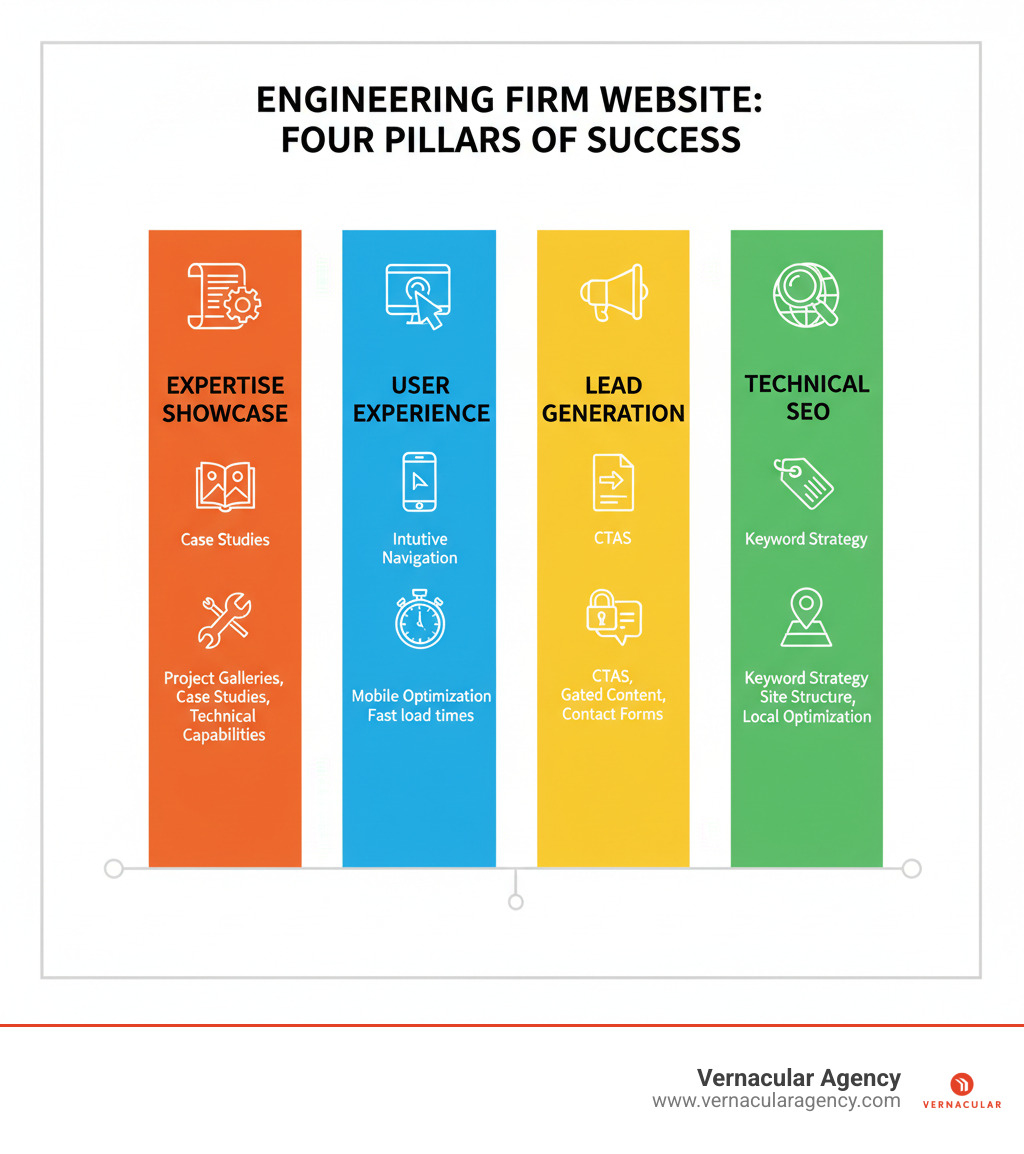
Your website is the foundation of your digital presence, where potential clients and top talent make critical decisions. The best sites make complexity feel simple, guiding visitors effortlessly from curiosity to action.
Let's look at what makes this happen.
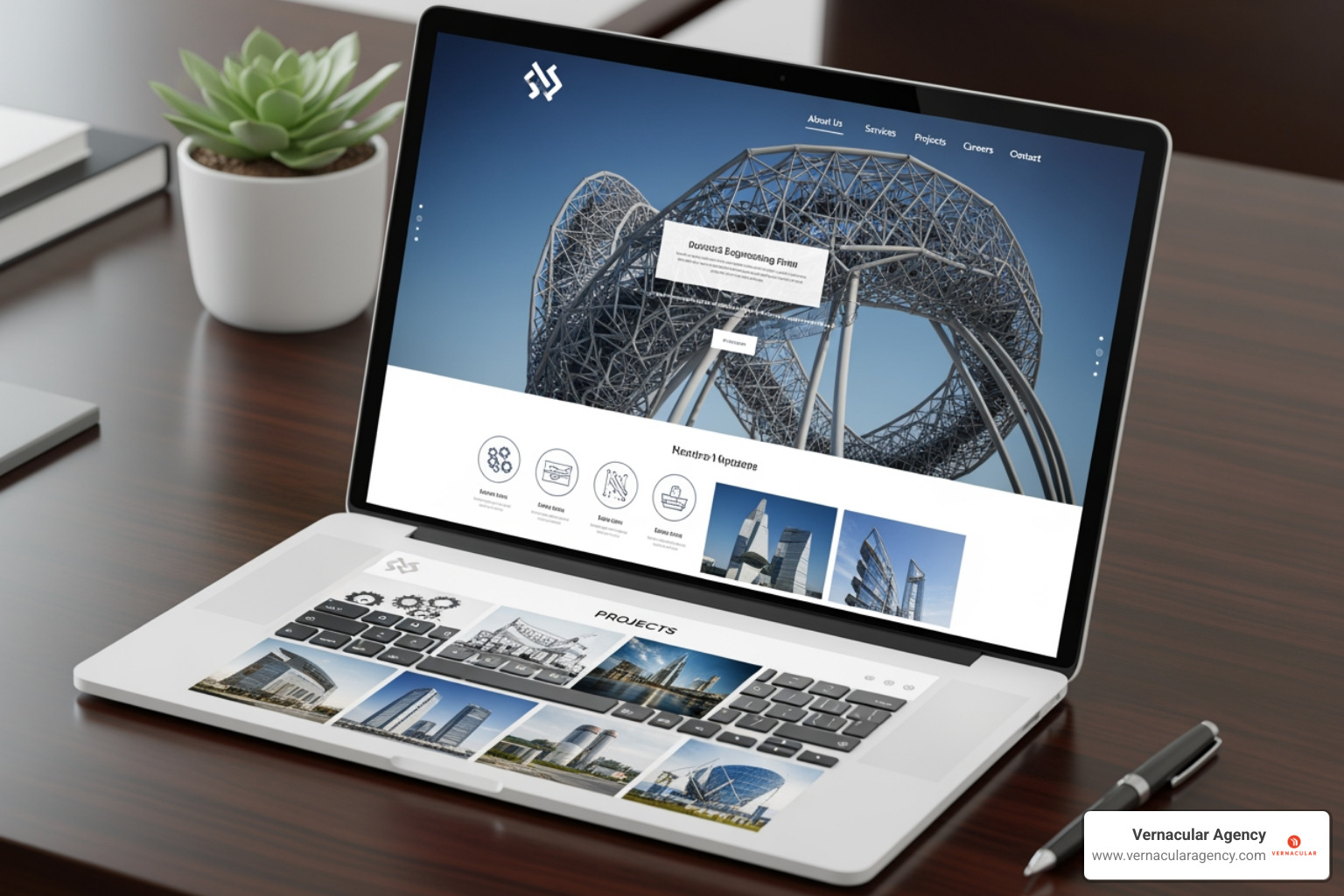
Confusing website navigation is like a construction site with no map—visitors will leave. The best firms organize content around how clients think. A service-based organization (structural, environmental) is good, but market-based categories (Energy, Water, Infrastructure) can be even more effective, letting visitors find relevant expertise instantly.
The goal is findability, with every page accessible in three clicks or less. Your menu should reflect your clients' needs, not your internal org chart. For more on this, our guide to Architecture Website Design offers practical frameworks.
Engineering is visual, and your website must show it. High-quality project photography is non-negotiable; it proves your capabilities and transforms technical work into compelling stories. A minimalist identity often works best, letting the projects be the hero.
Brand consistency across all materials builds recognition and trust. Your color palette, typography, and photo style should be cohesive. Video integration adds another dimension. A short video of your lab's capabilities, like this example, can communicate technical rigor more effectively than pages of text. Your visual design should embody your firm's unique Brand Identity.
If your site takes more than three seconds to load, you're losing visitors. Fast load times are table stakes. But speed isn't enough; the content must be approachable. Avoid dense paragraphs of jargon. Reduce text density by breaking up content with visuals and clear headings, and use white space to give information breathing room.
Clear Calls-to-Action like "Explore Our Projects" or "Discuss Your Needs" should guide visitors to the next step. Finally, adhering to accessibility standards (WCAG) is not only good ethics but also good business, demonstrating attention to detail. These principles are the foundation of effective Web Development that builds trust.
Your website is a stage for your best work. It’s where you prove your firm’s value by telling the story of your capabilities through your projects and people. Communicating this excellence is key to earning the kind of loyalty that leads to a 91% client return rate.
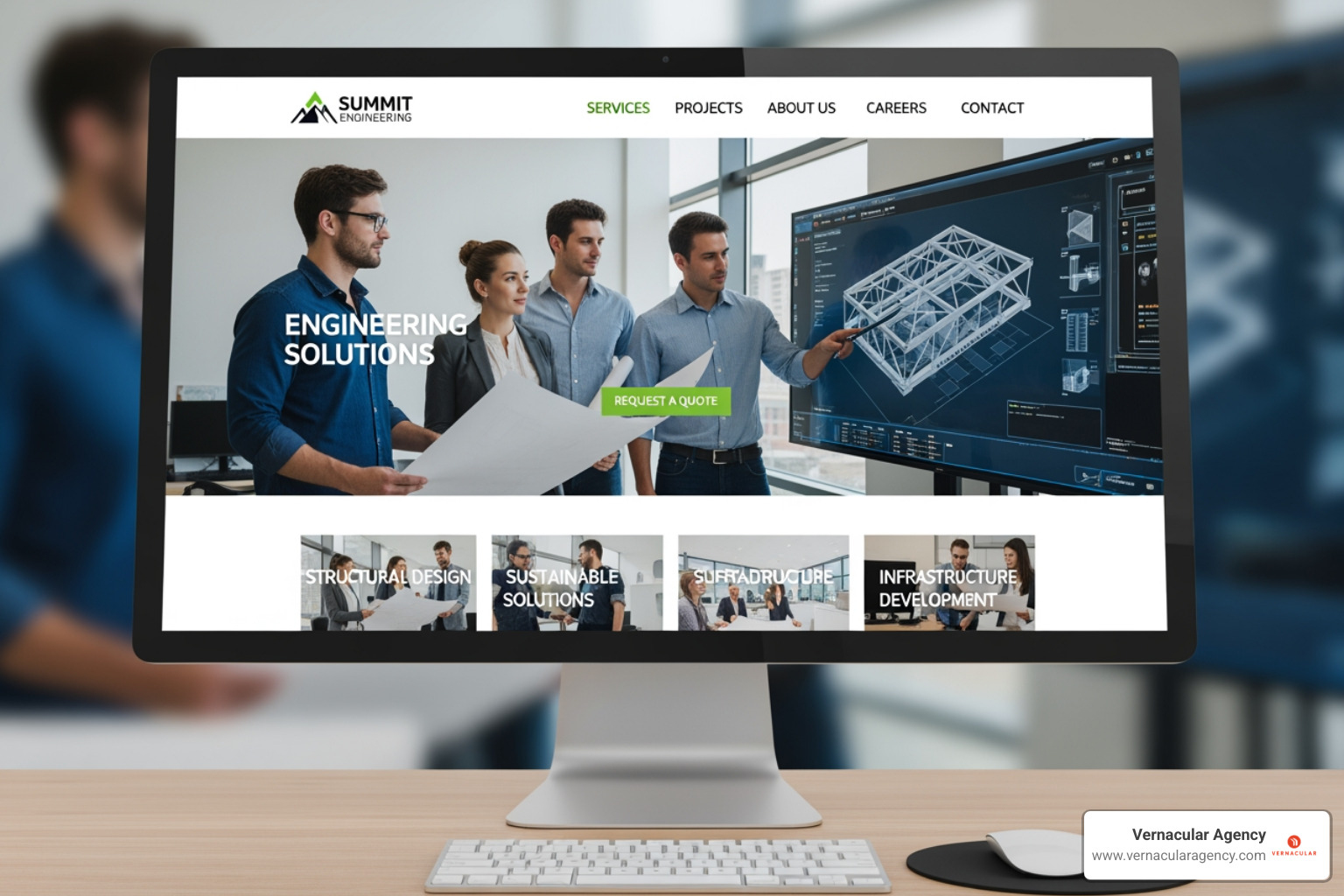
Your portfolio makes technical excellence visible. Use high-resolution imagery to capture the scale, precision, and innovation of your work. But photos alone aren't enough. Add detailed descriptions that explain the challenges overcome, the innovative solutions applied, and the project's measurable impact.
Make your portfolio searchable and filterable by sector and region. This practical touch helps visitors quickly find relevant experience. Showcasing diverse sectors—energy, water, transportation—demonstrates your versatility. For more inspiration, our insights on Best Architecture Firm Websites apply equally well to engineering.
A portfolio shows what you built; a case study shows how you think. Structure them with a clear problem, solution, result format. Use quantifiable data, like a 5.3x boost in website traffic, to offer concrete proof of your value.
Client testimonials add a layer of credibility your own words can't match. Video testimonials are particularly effective at capturing genuine enthusiasm and building trust. These authentic stories are central to any effective Marketing Strategy for Architects and are just as powerful for engineers.
Your people are your key differentiator. Your site should celebrate them. Go beyond credentials in expert bios; share specializations, achievements, and relatable details. Employee testimonials offer an inside look at your culture, building client confidence.
Showcasing your firm's diverse disciplines—from geotechnical engineers to environmental scientists—underscores your comprehensive capabilities. Highlighting technical luminaries who speak at conferences or publish research positions your firm as an industry innovator that helps set standards, not just follow them. This focus on your team is an essential part of your Brand Identity for Architects and engineering firms alike.
Your website serves a dual purpose: attracting high-value clients and the talented engineers who can deliver for them. In a competitive industry, your site must excel at both missions.

Your website is the first conversation with a potential client, and it needs to lead somewhere. Clear calls-to-action guide visitors toward requesting a consultation or quote. Gated content, like whitepapers on infrastructure challenges, offers real value in exchange for contact information, capturing qualified leads.
Strategically placed contact forms—on service pages, after case studies, and in the main navigation—make it easy for prospects to reach out. These tactics align with proven strategies for Lead Generation for Architects and Digital Marketing for Architecture Firms.
Top talent wants to know what it's like to work at your firm. A career portal should answer that question compellingly. Use "Life at..." sections with employee stories and photos to bring your culture to life. Authenticity matters, as shown by firms like Kimley-Horn, which backs up its claims with team member ratings.
Show clear career paths and professional development opportunities to prove that engineers can grow with you. Showcase real people doing meaningful work and make applying easy—a direct link to Explore open positions removes friction from the process.
Your site gains value when it contributes to industry conversations. A dedicated insights or blog section positions your team as authorities. Address client challenges like decarbonization or sustainable infrastructure. When AECOM discusses the energy sector's transition, they demonstrate expertise and start important conversations.
Publishing original research and whitepapers cements your reputation as an innovator. This thought leadership improves credibility and attracts top talent. It also boosts search visibility, as detailed in our guide to SEO Strategies for Architects. You can Read about the future of infrastructure to see how leading firms do this.
A beautiful website is useless if clients can't find it or use it on their devices. Technical excellence is what connects your digital presence to your business goals. Precision matters as much in digital engineering as it does in structural engineering; your site's technical foundation is critical for success.
Clients find firms by searching terms like "civil engineering firm Boston" on Google. Without SEO, you're invisible. A strong keyword strategy is the backbone, focusing on the terms your ideal clients use. On-page SEO (optimizing titles, headings, alt text) helps search engines understand your content, while technical SEO ensures your site is fast, crawlable, and well-structured.
For firms with physical offices, local SEO is critical for appearing in "near me" searches and map results. Our work with Woodhull, which increased their traffic by 5.3x, shows how powerful this is. For a comprehensive approach, see our SEO for Architects Complete Guide or our specialized SEO Website Optimization & Management services.
A potential client on a job site won't tolerate a slow, clunky mobile site. Mobile-first design is essential, as over half of all web traffic is now mobile. Your site must prioritize these users.
This means ensuring cross-device compatibility, touch-friendly navigation, and fast mobile loading speeds. The experience on a phone must be as professional as on a desktop, making your firm accessible wherever clients are. Our guide on Website Design for Architects covers these principles in detail.
Forward-thinking firms use emerging tech to stand out. Consider these innovations:
Digital innovation isn't about flashy features; it's about finding better ways to communicate your expertise and position your firm as a leader.
The best website for an engineering firm that’s a global corporation is different from one for a regional specialist. While design fundamentals are constant, your strategy must match your firm's scale and focus. A large firm is like a symphony orchestra, showcasing breadth; a small firm is a jazz quartet, emphasizing intimacy and agility.
| Feature | Large Firm Website Strategy | Small Firm Website Strategy |
|---|---|---|
| Primary Focus | Global reach, brand authority, investor relations | Niche expertise, local market penetration, personal connections |
| Content Scope | Broad services, diverse markets, corporate responsibility | Specialized services, specific case studies, team profiles |
| Geographic Presence | Multiple languages/regions, global project maps | Localized content, community involvement |
| Key Differentiator | Scale, diverse capabilities, financial stability | Agility, personalized service, deep local knowledge |
| Investor Relations | Dedicated sections, financial reports | Less emphasis, direct client engagement |
For a firm with 75,000 employees and 200,000 projects, a website must support global operations. This means multi-language support and regional content variations. These sites often need dedicated investor relations sections with financial reports and extensive newsrooms like Fluor's press release center.
Showcasing corporate responsibility, sustainability, and community investment is also key for large firms, as these are often deal-makers for major infrastructure projects. The site's primary goal is to demonstrate the capacity to handle massive, complex projects anywhere in the world.
A specialized firm shouldn't mimic a global giant. Your strength is depth and personal connection, not breadth. A firm like Sebago Technics, a civil engineering firm serving New England, focuses its website on its unique value: deep local knowledge, regional relationships, and responsive service from accessible principals.
Small firm websites shine when they emphasize the personal touch. Feature your team, share stories about local projects, and highlight community involvement. Your agility is a key asset—you can pivot quickly and provide customized solutions. Your website should communicate this through case studies that highlight close client collaboration. You don't need to be everything to everyone, just the best choice for the clients you serve.
Your website is your digital headquarters, where major decisions are made by clients, talent, and peers. Every element works together: intuitive navigation, compelling visuals, a strong career portal, and a solid technical foundation with SEO and mobile optimization.
The difference between a passive website and one that actively grows your business is intentional strategy. By organizing content thoughtfully, showcasing your people authentically, and building trust, your site becomes your most powerful marketing tool.
Whether you're a global giant or a focused local practice, the principles are the same. Your website must reflect the precision and innovation you bring to every project.
At Vernacular Agency, we help engineering and architecture firms transform their digital presence. We know that the right blend of design and strategy delivers real growth, leads, and impact.
Your firm's legacy deserves a digital foundation built to last. Ready to create an engineering firm website that showcases your expertise and drives your business forward? Build your firm's digital foundation with us, and let's engineer something remarkable together.
