

Architect marketing strategies are the structured systems that help firms attract ideal clients, generate qualified leads, and grow sustainably — without relying on luck or referrals alone.
Here are the most effective strategies at a glance:
If you've been in practice for any length of time, you already know the feeling: projects flood in for a few months, then suddenly go quiet. This feast-or-famine cycle isn't a sign of bad work — it's usually a sign of inconsistent marketing. The hard truth is that most architecture firms either market reactively, or not at all. Meanwhile, over 80% of potential clients are researching architects online before ever making contact, and firms without a visible digital presence simply don't make the shortlist.
The good news? A clear, strategic approach can change that.
I'm Rebecca Falzano, Creative Director with nearly 15 years of experience shaping compelling brand narratives — and I've seen how the right architect marketing strategies transform a firm's ability to attract the right clients and projects. In the sections ahead, we'll break down exactly how to build that system.
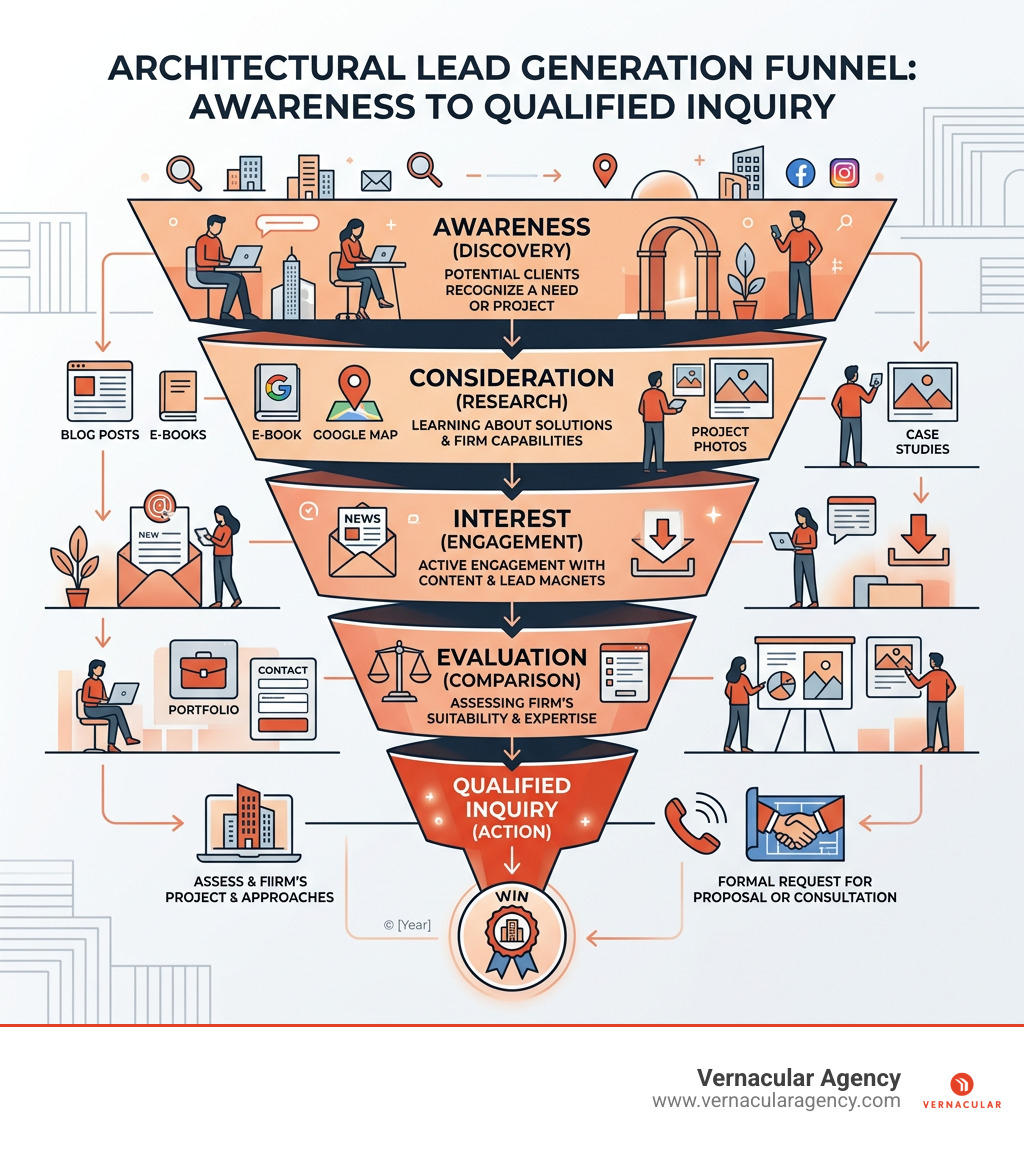
Discover more about Architect marketing strategies:
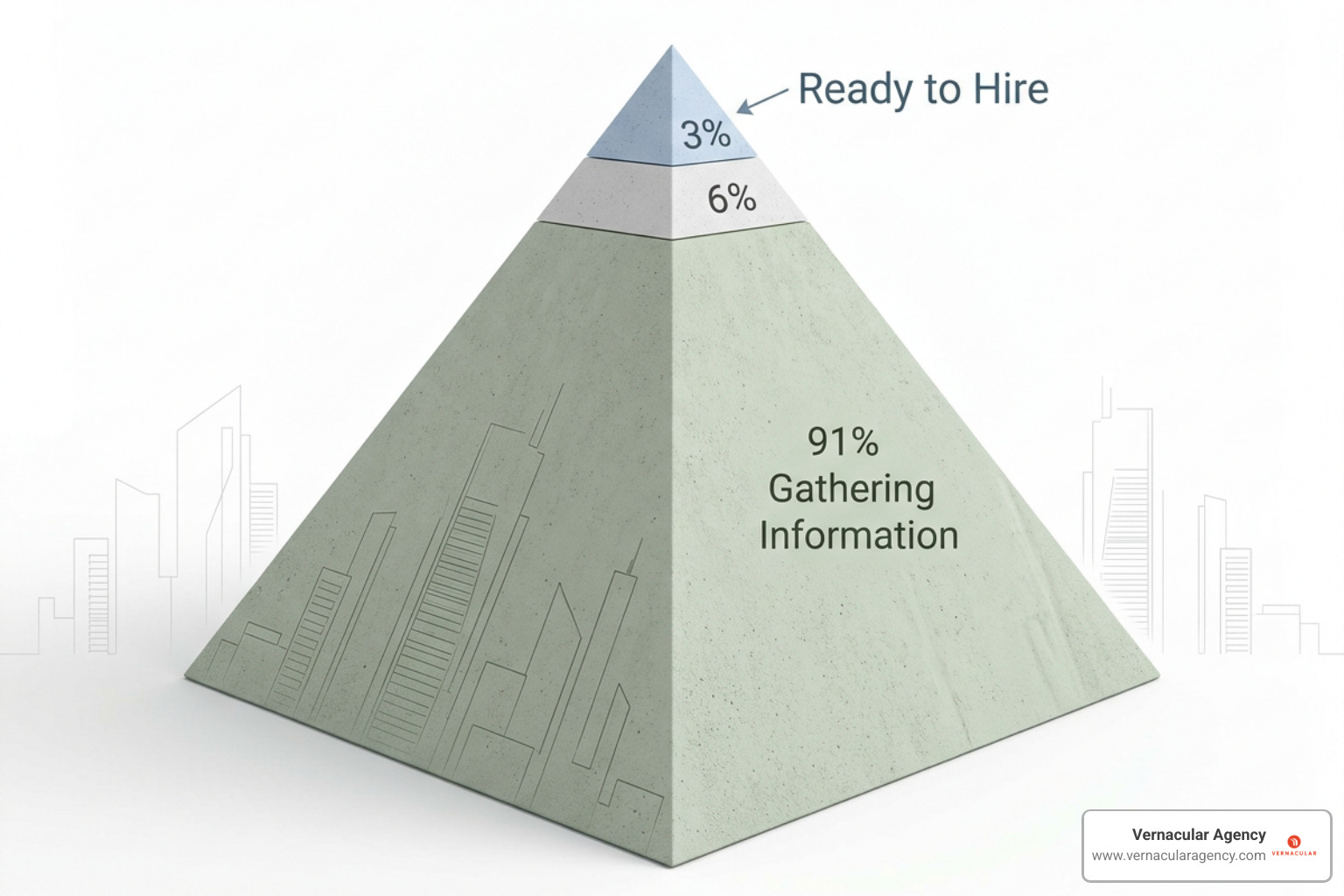
To understand why most marketing fails, we have to look at the Client Demand Pyramid. Imagine a pyramid divided into three sections. At the very tip—the top 3%—are the people ready to hire an architect today. They have the budget, the land, and the urgency.
The problem? Almost every firm in the country is fighting over that 3%. They run ads that say "Hire Us" or "Award-Winning Firm," which only appeals to people ready to sign a contract immediately.
However, the real gold is in the bottom 91%. These are people in the "information-gathering" or "idea-gathering" phase. They know they want to build or renovate eventually, but they are terrified of making a mistake, going over budget, or hiring the wrong person. If you only target the top 3%, you are ignoring 91% of your potential market. By the time those people move to the top 3%, they’ve already built a relationship with the architect who helped them during their research phase.
Effective architect marketing strategies focus on capturing these leads early. This is where a solid Architecture Marketing Plan becomes your best friend, shifting your focus from "selling" to "helping."
In sailing, a "Monkey's Fist" is a small, weighted knot at the end of a rope. It’s easy to throw across a distance to someone on a pier. Once they catch the small knot, they can use it to pull in the heavy heaving line.
In marketing, your Monkey's Fist is a piece of high-value educational content. Instead of asking for a $50,000 design fee right away (the heavy rope), you offer a "How-To Guide for Coastal Maine Renovations" or a "Budgeting Checklist for Custom Homes" (the Monkey's Fist).
Does it work? Statistics show that the Monkey's Fist strategy can return results 500% greater than traditional "hire me" marketing. We've seen cases where:
This is the essence of Lead Generation for Architects. You provide value first, establish authority, and build trust so that when they are ready to hire, you are the only logical choice.
For a long time, architects didn't really "market." In fact, until 1972, the US Department of Justice had to intervene to abolish professional restrictions that essentially banned architects from advertising. Because of this history, many firms still rely on "Hope Marketing"—the hope that the phone will ring because the work is good.
But advertising and marketing are not the same thing. Advertising is paying for space (like a print ad in a magazine) to shout at people. Marketing is the entire process of making prospects aware of your value and persuading them to take the next step.
| Feature | The 3% 'Hire Me' Tier | The 91% 'Idea Gathering' Tier |
|---|---|---|
| Client Mindset | Ready to sign; price-sensitive; comparing firms. | Seeking education; nervous; looking for a guide. |
| Marketing Goal | Immediate conversion / Sale. | Build trust; capture email; establish authority. |
| Content Type | Portfolio; Awards; Fee proposals. | Guides; Checklists; Case studies; "How-to" blogs. |
| Competition | Extremely high; everyone is here. | Very low; most architects ignore this group. |
Your website is no longer just a digital brochure; it is your 24/7 salesperson. When 84% of AEC (Architecture, Engineering, and Construction) clients visit a website before making contact, your online presence is your firm's most important asset.
However, many firms fall into "Portfolio Pitfalls." They show beautiful, empty buildings with no people in them and provide zero context about the problems they solved. A high-conversion website must balance aesthetics with user experience (UX). It needs to be mobile-responsive, fast-loading (losing visitors if it takes more than 3 seconds), and have clear Calls to Action (CTAs).
If you want to dive deeper into how to structure your site, check out our guide on Digital Marketing for Architecture Firms.
If someone in Portland, Maine, searches for "residential architect near me," does your firm show up? If not, you’re losing work to firms that might have less experience but better SEO.
Local SEO is the practice of optimizing your online presence to attract more business from relevant local searches. Key components include:
For a step-by-step blueprint, see our SEO for Architects Complete Guide.
We live in an era of transparency. 99% of consumers check reviews before making a purchase, and architecture is no different. Prospective clients want to know what it’s actually like to work with you.
Don't be afraid to ask for testimonials. A few glowing sentences about how you saved a client money or navigated a difficult zoning board are worth more than ten awards. Manage your reputation by responding to every review—even the rare negative ones—with professionalism and grace. This builds "E-E-A-T" (Experience, Expertise, Authoritativeness, and Trustworthiness), which Google loves. This trust-building is a core pillar of Architecture Firm Branding Ultimate Guide.
Architecture is inherently visual, but pretty pictures aren't enough. You need to tell the story of the project. Why was that window placed there? What was the client's biggest fear, and how did you solve it?
Educational blogs are the engine of Content Marketing Architects. Instead of just "Project X Gallery," try writing "5 Things to Know Before Starting a Coastal Renovation." This positions you as an expert and helps you rank for the questions your 91% audience is actually asking.
Not all social media platforms are created equal for architects. Here is how we recommend using them:
Video is the most engaging medium on the planet. In fact, videos get 1200% more shares than text and images combined. For architects, this is a massive opportunity.
You don't need a Hollywood crew. Use your phone to do a walkthrough of a finished project or a "sketch-to-site" time-lapse. Cinematic animations and 3D tours allow clients to "feel" the space before a single brick is laid. This level of transparency builds incredible trust and is a key part of an Architecture Firm Digital Strategy Guide.
The architectural sales cycle is long—often 6 to 18 months. If someone downloads your "Monkey's Fist" guide today, they might not be ready to hire you until next year. If you don't stay in touch, they will forget you.
This is where email marketing and automation come in. By using a CRM (Customer Relationship Management) system, you can set up "drip campaigns" that automatically send a helpful email every few weeks.
This keeps you front-of-mind without you having to manually type an email every day. Learn more in our Email Marketing for Architects Guide.
To stand out in a crowded market, you need to define your 4 Ps. This is how we help firms differentiate themselves from the "sea of sameness":
Defining these clearly is the first step in our Architect Firm Branding Complete Guide.
We know you're busy. You don't have time to be a full-time content creator. The secret is to "work once, use many."
This creates a sustainable system that keeps your firm visible without overwhelming your team. It’s all about working smarter, not harder, on your Architecture Firm Marketing.
Traditional print ads in glossy magazines are beautiful, but they often yield zero chargeable work. Why? Because they target everyone, regardless of where they are in the buying journey, and they offer no way to track ROI. A UK firm once spent £4,500 on print ads and got zero results. Digital strategies allow you to target the right people at the right time.
For established firms looking to maintain their position, 3-5% of gross revenue is standard. However, for firms under $5M that want to scale and grow, we recommend investing 7-10% of gross revenue into proactive marketing and brand building.
Marketing is a marathon, not a sprint. While you can get "quick wins" from networking or paid ads in a few weeks, a robust SEO and content strategy typically takes 6-12 months to show significant, consistent results. It’s like growing a tree; you have to water it before you can sit in the shade.
At Vernacular Agency, we believe that great design deserves to be seen. You've spent years mastering the art of architecture; let us help you master the art of attracting the clients you truly want to work with. From our home base in Portland, Maine, we help firms across the country escape the feast-or-famine cycle through precision-engineered architect marketing strategies.
Don't let your firm's growth happen by accident. By targeting the 91%, utilizing the Monkey's Fist strategy, and building a high-conversion digital presence, you can build a practice that is as stable as the structures you design.
Ready to take the next step? Optimize your firm's digital foundation today and let's start building your future together.