

Setting an architecture firm marketing budget is no longer optional—it's essential for growth. Here's what you need to know:
Quick Answer: Industry Benchmarks for Architecture Marketing Spend
With budget season just behind us, your marketing efforts may have been under the microscope. Many architecture firm leaders are discovering that the informal marketing approaches that worked for boutique studios no longer support growth as firms scale. Without a clear marketing spend strategy, firms risk inefficiency, missed opportunities, and losing ground to competitors who are investing strategically.
The stakes are high. Marketing isn't a discretionary expense—it's a strategic investment that fuels your pipeline, shapes your reputation, and attracts the clients you want to work with. Hundreds to tens of thousands of prospects search daily for architecture services, and appearing before them requires intentional budget allocation.
Over the past six years, architecture firm marketing budgets have expanded significantly as digital channels become central to business growth. The shift from traditional relationship-building to integrated digital strategies means firms must think differently about how they allocate resources across SEO, content marketing, social media, and other channels.
I'm Rebecca Falzano, Creative Director at Vernacular Agency, and I've spent nearly 15 years guiding content creation and storytelling for design-focused businesses, working with architecture firms to develop architecture firm marketing budget strategies that drive measurable growth. Throughout this guide, we'll walk through the benchmarks, allocation strategies, and common pitfalls that will help you right-size your investment for maximum impact.
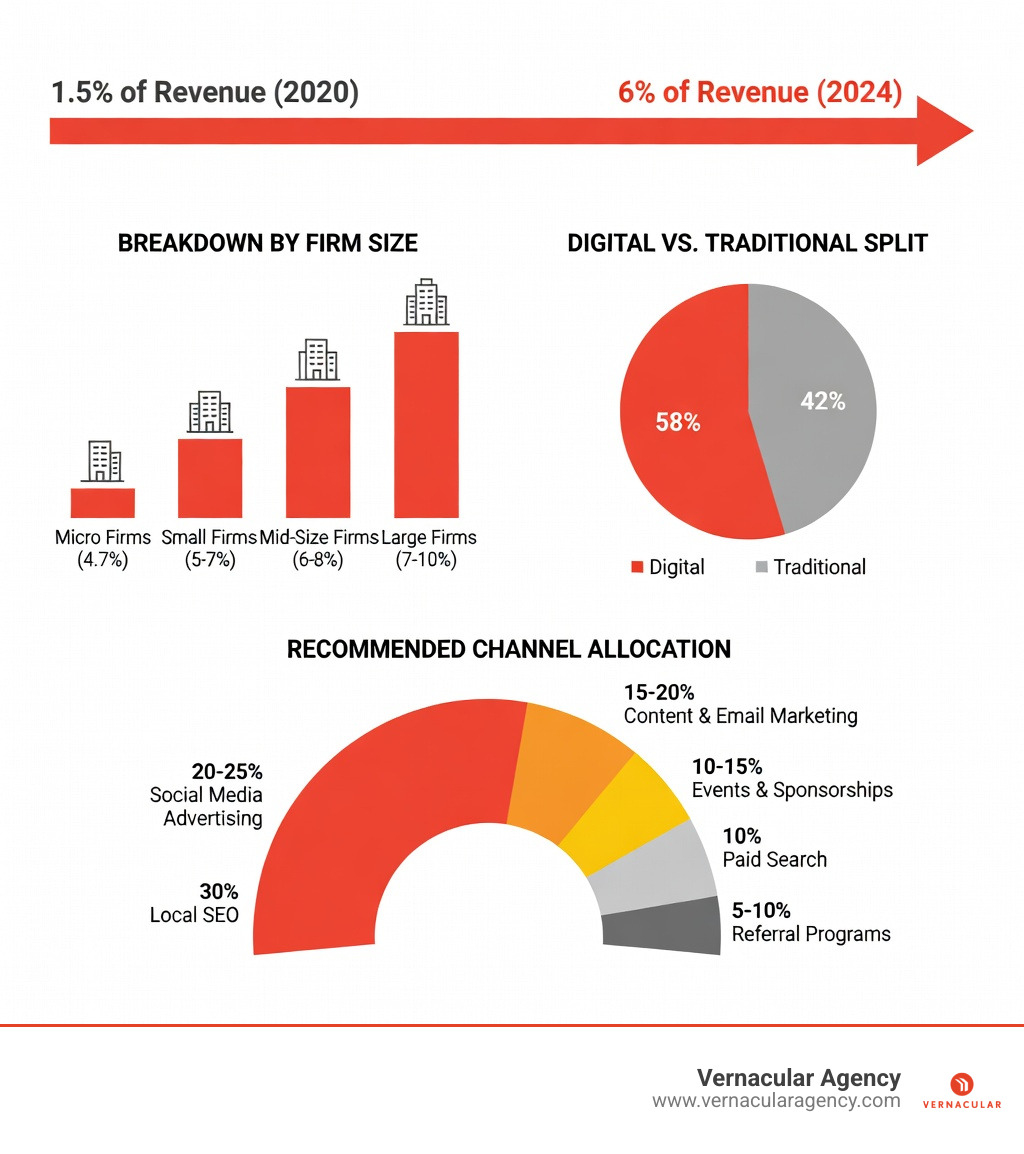
Architecture firm marketing budget terms at a glance:
When we sit down with firm principals in Portland, Maine, or anywhere across the US, the first question is always: "What is the magic number?" While there is no one-size-fits-all answer, we can look at data-driven benchmarks to find a starting point.
Most industry sources, including the Society for Marketing Professional Services (SMPS), recommend that architecture and engineering firms allocate between 3% and 5% of their net service revenue to marketing and business development. However, recent trends show that firms aiming for aggressive growth or those operating in highly competitive markets often push this figure closer to 7% or even 10%.
To calculate your budget, you first need to decide if you are basing it on Gross Revenue (total billings) or Net Service Revenue (gross revenue minus pass-through expenses like consultants). Most firms find it cleaner to use a percentage of gross annual revenue.
| Firm Size | Revenue Range | Recommended Budget % | Estimated Annual Spend |
|---|---|---|---|
| Micro | <$250K | 4.7% | ~$11,750 |
| Small | $250K - $1M | 5% - 7% | $18,750 - $52,500 |
| Mid-size | $1M - $5M | 6% - 8% | $60,000 - $400,000 |
| Large | $5M+ | 7% - 10% | $350,000+ |
For a deeper look at how management principles affect these numbers, you can reference AIA industry benchmarks on firm management.
Your specialization significantly impacts how you should spend your dollars. Not all projects are won the same way, and your budget should reflect your specific sales cycle.
To see how these specializations fit into a broader plan, check out our Architecture Marketing Strategy Complete Guide.
We like to think of a marketing budget like horsepower in a car: how fast do you want to go?
Once you have your total number, the next challenge is slicing the pie. In the past, architecture marketing was almost entirely "traditional"—lunches, print ads in local magazines, and golf outings. Today, digital channels receive 56-58% of architecture firm marketing budgets.
A well-balanced architecture firm marketing budget should prioritize "Below the Line" (BTL) targeted activities that drive conversions. According to professional services marketing spend research, digital integration is no longer a luxury; it is the primary way modern clients vet their professional partners.
One of the most common mistakes we see is firms failing to account for labor costs. If your Lead Architect is spending 10 hours a week on social media and RFPs, their billable rate should technically be part of your marketing spend.
To "right-size" your budget, you must decide between in-house personnel and outsourcing.
For a step-by-step breakdown of these costs, see our guide on a Marketing Plan for Architecture Firm.
If you want the best ROI, we recommend the following allocation for your digital spend:
As noted in the Gartner CMO Spend Survey insights, digital channels are where modern "CMOs" (or in your case, Principals) are doubling down to ensure resilience during tough times.
Your budget shouldn't be static. It needs to breathe with the market and your firm's lifecycle.
Several key factors will dictate whether you should lean toward the 3% or 10% mark:
"I know half my marketing budget is wasted; I just don't know which half." This old saying doesn't have to be true for your firm. By tracking Key Performance Indicators (KPIs), you can turn your budget into a precision tool.
What to track:
Common Pitfalls to Avoid:
For more on running a successful drive, visit our Marketing Campaign Ultimate Guide.
For a firm with revenue between $250,000 and $1M, the average budget is 5-7%, which equates to roughly $18,750 to $52,500 per year. This usually covers a website refresh, ongoing SEO, professional project photography, and basic social media management.
Yes. In the AEC industry, marketing and business development (BD) are often intertwined. To get a true picture of your investment, you should include the labor costs of staff dedicated to proposals, networking, and lead nurturing.
We recommend a deep dive once a year during budget season, with "pulse checks" every quarter. Digital marketing allows for real-time adjustments; if a specific ad campaign is driving high-quality leads, you may want to shift more budget there mid-year.
Right-sizing your architecture firm marketing budget is one of the most impactful things you can do for the long-term health of your practice. It moves your firm away from the "feast or famine" cycle of referrals and into a position of proactive growth.
At Vernacular Agency, we specialize in helping architects in Maine and across the country find that "sweet spot" where creativity meets data-driven results. Whether you are looking to refresh your Architecture Firm Branding Ultimate Guide or need a comprehensive Architecture Marketing Plan Template Ultimate Guide, we are here to help.
Ready to stop being your area's best-kept secret? Explore our comprehensive marketing services and let's build something brilliant together.
