
CTV media buying is the process of planning, purchasing, and optimizing ad inventory across streaming TV platforms — like Hulu, Roku, Peacock, and Netflix — using programmatic technology or direct deals.
Here's a quick breakdown:
| What it is | Buying ad space inside streaming TV content on internet-connected devices |
|---|---|
| How it works | Automated bidding, private deals, or direct buys through a DSP or platform |
| Who it's for | Brands and marketers wanting to reach TV audiences with digital-level precision |
| Why it matters | Over 90% of U.S. CTV ad spend now flows through programmatic pipes, and budgets are growing fast |
| Key advantage | Combine TV's visual impact with the targeting and measurement of digital advertising |
TV viewing has shifted dramatically. More than 250 million Americans now stream content on connected devices, and cord-cutting shows no signs of snowboarding. Advertisers who still rely solely on traditional linear TV are missing a huge — and highly engaged — audience.
The stakes are real. Nearly 70% of CTV advertisers plan to grow their budgets in 2026 by an average of 17%. U.S. CTV ad revenues are projected to hit roughly $42.4 billion by 2027, and CTV spend is on track to surpass linear TV entirely by 2028.
But here's the problem: CTV doesn't usually fail — it gets bought badly. The ecosystem is fragmented, fraud rates are high, and without the right strategy, budgets disappear fast with little to show for it.
I'm Rebecca Falzano, Creative Director at Vernacular Agency, and while my roots are in editorial storytelling and content strategy, I've spent years helping brands navigate complex media landscapes — including ctv media buying — to craft campaigns that are as measurable as they are compelling. In this guide, I'll walk you through exactly how to buy CTV the right way.
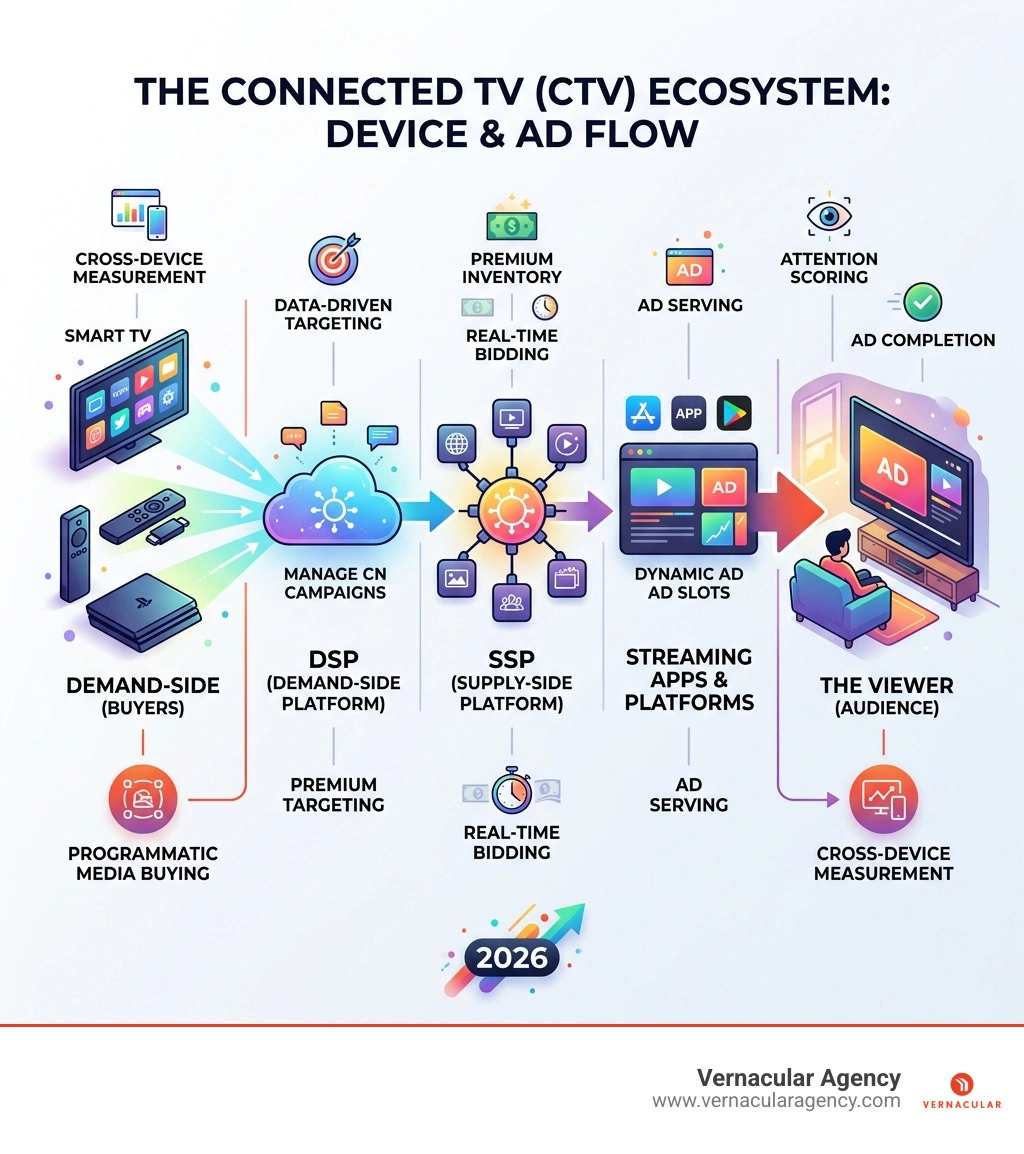
To master ctv media buying, we first need to clear up the "alphabet soup" of the industry. Connected TV (CTV) refers to the physical hardware used to stream video content. This includes Smart TVs with built-in internet, gaming consoles (like Xbox or PlayStation), and streaming sticks (like Roku, Amazon Fire TV, or Apple TV).
Often, you'll hear the term "OTT" (Over-the-Top) used interchangeably with CTV. However, there is a subtle difference. OTT refers to the service or the method of delivery—content provided over the internet bypassing traditional cable or satellite. CTV is the device where that content is consumed. When we talk about ctv media buying, we are specifically looking to place ads on that big screen in the living room, which offers the highest viewer attention scores in the digital world—averaging about 69.5% attention compared to much lower rates for mobile or desktop video.
The penetration of these devices is staggering. Globally, over 1.2 billion households own at least one Smart TV, a number growing at 16% year-over-year. In the U.S., the shift is even more pronounced as linear TV—the traditional "appointment viewing" on broadcast networks—continues to lose ground to on-demand streaming.
| Feature | Linear TV | OTT (Over-the-Top) | CTV (Connected TV) |
|---|---|---|---|
| Delivery | Cable, Satellite, Antenna | Internet (Apps/Web) | Internet (Smart TV/Console) |
| Targeting | Broad (Demographics/Ratings) | Precise (IP/Behavioral) | Precise (Household/1:1 ID) |
| Measurement | Estimates (Nielsen) | Digital Metrics (Clicks/Views) | Performance Metrics (VCR/Attribution) |
| Inventory | Fixed Schedule | On-Demand | On-Demand on TV Screens |
For businesses looking for a Media Buying Agency Maine, understanding these distinctions is the first step toward moving away from "spray and pray" advertising and toward data-driven results.
In the old days of TV, buying an ad meant calling a rep, looking at a spreadsheet of ratings, and hoping your target audience was watching "Jeopardy" at 7:00 PM. Today, ctv media buying is powered by "programmatic pipes." This means the process is automated, using software to buy and sell inventory in real-time.
This shift allows for incredible inventory control. We aren't just buying a time slot; we are buying an audience. Whether that audience is watching a hit series on Netflix, a live game on Peacock, or a movie on Hulu, our ads follow the viewer, not the program. Furthermore, the entry of ad-supported tiers on premium platforms like Disney+ and Netflix has flooded the market with high-quality, brand-safe inventory that was previously unreachable. Approximately 90% of all CTV impressions now come from just 10 major publishers, ensuring that your brand stays in premium company.
Executing a campaign isn't as simple as clicking "upload." It requires a technical setup that ensures your creative looks beautiful on a 65-inch 4K screen and that your data is tracking correctly.

For many of our clients, we handle this through our specialized Service/Media Buying team, ensuring that every dollar is spent where it has the most impact.
A common question we get in Portland, Maine, is: "How much should I spend?" While budgets vary, industry benchmarks suggest allocating 15% to 30% of your total digital ad budget to CTV to achieve statistically valid results.
One of the most important parts of planning is Supply Path Optimization (SPO). In the complex world of programmatic ads, a single ad slot on an app like Hulu might be available through 100 different "paths" or middlemen. If you aren't careful, you could end up bidding against yourself or paying unnecessary fees to intermediaries. By using SPO, we find the shortest, most transparent path to the publisher, which reduces waste and ensures more of your budget goes toward actual views.
Another key factor is frequency management. Have you ever watched a show and seen the same ad four times in one break? That’s bad ctv media buying. It leads to "ad fatigue" and wastes money. We set frequency caps—usually 3 to 5 exposures per household per week—to keep your brand top-of-mind without becoming an annoyance.
There are three main ways to actually "buy" the media:
By bypassing unnecessary intermediaries, platforms like CTVBuyer help minimize fees and ensure cost-effectiveness for local and regional advertisers.
The real "magic" of ctv media buying is the data. Because these devices are connected to the internet, we can use the same granular targeting we use on social media or search.
We start with first-party data. If you have a list of email addresses from your current customers, we can upload that to the DSP, match those emails to household IP addresses, and show your ads specifically to your existing fans—or exclude them to focus entirely on new customer acquisition.
We also use household graphing. This technology understands that the person watching the Smart TV also has a laptop and a smartphone. If they see your ad on the TV and later browse your website on their phone, we can "stitch" those actions together to prove the TV ad drove the visit. This 1:1 ID matching is far more accurate than the old-school "GRP" (Gross Rating Point) estimates used in linear TV.
For a deeper dive into how this works locally, check out our Media Buying Maine Complete Guide.
We can get incredibly specific with our targeting layers:
In the past, TV was purely an "awareness" play. Today, it’s a performance channel. When we look at ctv media buying results, we focus on several key metrics:
No medium is perfect, and ctv media buying has its hurdles. The biggest is fragmentation. With hundreds of apps and dozens of device manufacturers, it’s easy for data to get lost.
Ad Fraud is another concern. Approximately 19% of global programmatic CTV traffic was flagged as invalid (IVT) in late 2025. Fraudsters use "bot farms" to simulate TV viewing and steal ad dollars. To avoid this, we use verification vendors like DoubleVerify or Integral Ad Science to ensure every impression is seen by a real human.
We also keep a close eye on transparency. Some platforms are "black boxes" that don't tell you exactly where your ads ran. We prioritize platforms that offer "radical transparency," showing us every app and every impression delivered. This level of detail is just as important in CTV as it is in other emerging channels like Digital Outdoor Media.
In 2026, average CPMs (cost per 1,000 impressions) for U.S. CTV campaigns typically range from $20 to $40, with most settling around $25. While this is higher than social media or display ads, the value lies in the 100% viewability and high completion rates. Prices can fluctuate based on the "premium-ness" of the content (e.g., live sports or hit HBO shows) and seasonal demand like the Q4 holiday rush.
CTV should never live in a vacuum. It works best as the "top of the funnel" that feeds your other channels. For example, a viewer sees your 30-second spot on their TV (Awareness). The next day, they see a retargeting ad on Instagram (Consideration). Finally, they search for your brand on Google and click a paid search link (Conversion). This "surround sound" effect makes every other channel more efficient. Direct response clients often see a 15% lower cost per sale when CTV is included in the mix.
Beyond VCR, we look at Reach and Frequency (how many unique households saw the ad and how often), ROAS (Return on Ad Spend), and Attention Scores. In 2026, we are also seeing a rise in "New-to-Brand" metrics, which track how many customers your CTV ad brought in who had never interacted with you before.
The future of ctv media buying is bright, driven by AI-powered optimization and increasingly personalized ad experiences. We are moving toward a world where two neighbors watching the same show might see two completely different ads tailored to their specific interests and needs.
At Vernacular Agency, we believe that the most successful brands are the ones that marry the "big screen" impact of television with the surgical precision of digital data. Whether you are a local business in Portland or a national brand looking to scale, the time to claim your space on the living room screen is now.
Ready to see what CTV can do for your brand? More info about media buying services is just a click away. Let's build something that gets noticed—and gets results.