

Google Ads small business campaigns offer one of the most powerful ways to reach customers actively searching for your products or services. If you're evaluating whether Google Ads is right for your business, here's what you need to know:
Quick Answer: Is Google Ads Worth It for Small Businesses?
Best Campaign Types for Small Businesses:
Running a small business means stretching every marketing dollar. Many business owners worry their limited budgets can't compete with larger companies spending thousands daily. The reality? Google Ads rewards relevance and quality over pure spending power. With the right strategy, small businesses can achieve remarkable results—46% of all Google searches seek local information, and 72% of local searchers visit a business within five miles.
The challenge isn't whether Google Ads works for small businesses. It's understanding how to set up campaigns that deliver real results without wasting your budget on irrelevant clicks or broad keywords that drain your account.
I'm Rebecca Falzano, Creative Director at Vernacular Agency, where I've guided countless small businesses through the complexities of digital marketing and helped them craft campaigns that resonate with their target audiences. My experience developing strategic content and working with business owners has shown me that Google Ads small business success comes down to clear goals, smart targeting, and continuous optimization—not just throwing money at keywords and hoping for the best.
For small businesses in Maine and beyond, the digital landscape is a busy marketplace. Google Ads isn't just another advertising platform; it's a strategic tool that can profoundly impact your bottom line. We've seen how it can transform a small operation into a thriving enterprise.
The numbers speak for themselves: the average small-to-medium sized business can expect to make $8 in profit for every $1 they spend on a well-run Google Ads campaign. This isn't just about getting clicks; it's about generating a tangible return on investment (ROI) that fuels your growth. For us, this means crafting effective Digital Marketing for Architecture Firms and other local businesses, ensuring every dollar spent contributes to their success.
Imagine a potential customer in Portland, Maine, needs a specific service – say, an architect for a home renovation. They pull out their phone and type "architects Portland Maine" into Google. This isn't just a casual browse; it's an intent-based search. They're actively looking for a solution, often at the bottom-of-the-funnel, ready to make a decision.
This is where Google Ads shines. It allows your ad to appear at the very top of the search engine results page (SERP) precisely when these active buyers are problem-solving. We're not interrupting their experience; we're providing the answer they're searching for. This direct alignment with user intent leads to higher quality leads and better conversion rates, making it an incredibly efficient way for your Google Ads small business strategy to capture customers.
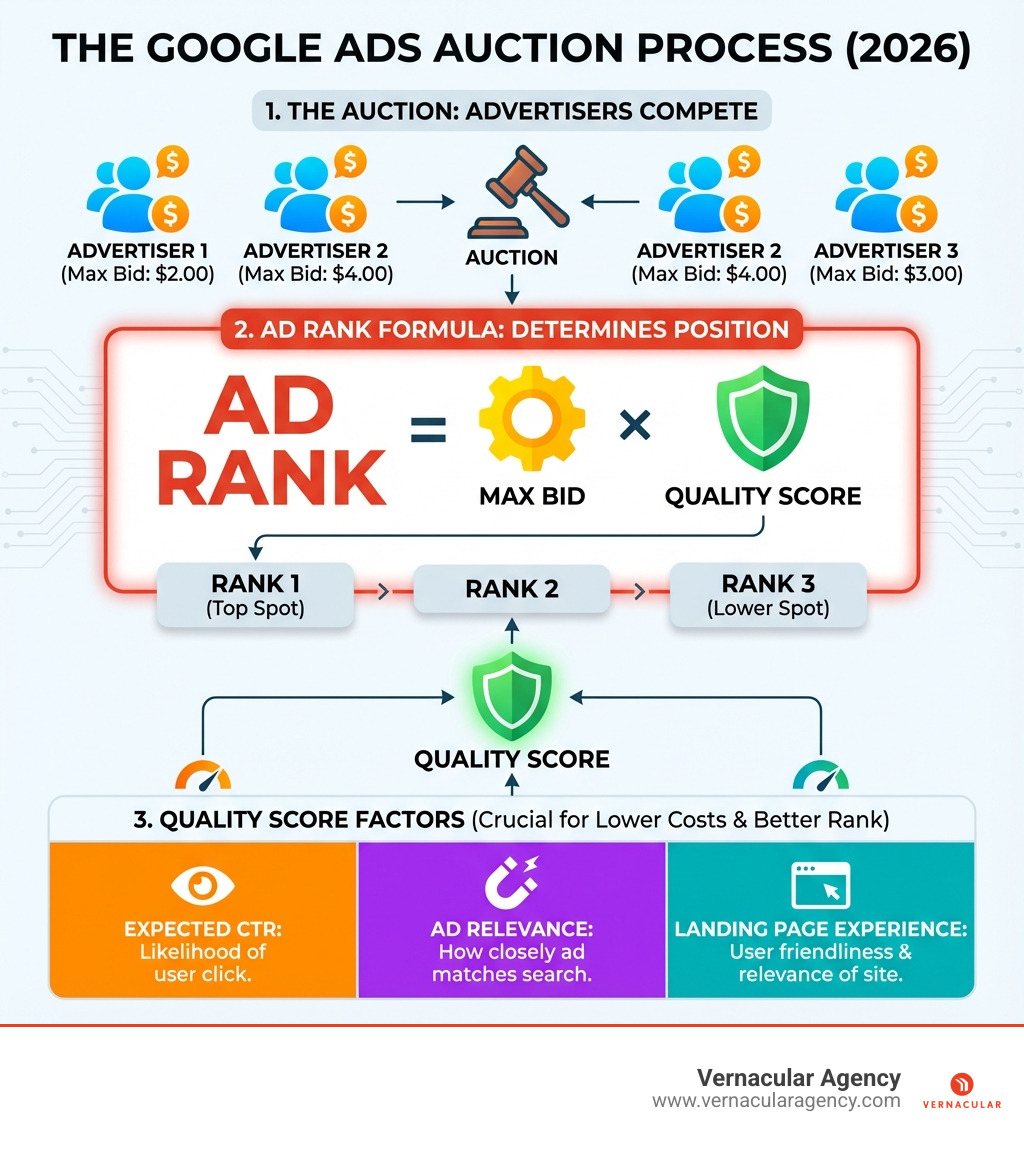
One of the biggest misconceptions we encounter is that small businesses can't compete with larger companies on Google Ads due to budget constraints. While big budgets certainly help, the Google Ads auction isn't solely about who bids the most. Google's algorithm prioritizes relevance and quality through something called Quality Score.
Your Quality Score is Google's rating of the quality and relevance of your keywords, ads, and landing pages, measured on a scale from 1-10. A high Quality Score (think 7 or higher) means your ads and landing pages are highly relevant to what users are searching for. This can lead to lower costs per click and better ad positions, even if you're not the highest bidder. Essentially, a well-optimized Google Ads small business campaign can often outrank a poorly optimized, high-budget campaign. It's a true meritocracy where smart strategy can beat sheer spending power.
As a small business, every penny counts. Google Ads understands this, offering robust tools to control your spending. With Google Ads, you decide how much money you want to spend, setting daily budget caps that ensure you never exceed your comfort zone. You only pay when someone clicks on your ad (the pay-per-click model) or, in some cases, when they make a call, not just for your ad being shown. This means your budget is allocated directly to engaging with potential customers.
Beyond controlling costs, Google Ads provides powerful conversion tracking features. We can set up tracking to monitor what happens after a customer interacts with your ads – whether they fill out a contact form, call your business, make a purchase, or download a brochure. This data-driven approach allows us to measure your Return on Ad Spend (ROAS) and continuously optimize your campaigns for better performance. This transparency ensures that your Google Ads small business investment is always working towards your goals.
Starting your first Google Ads campaign might seem daunting, but with a structured approach, it's entirely manageable. Think of it as building a house: you need a solid foundation before you start decorating. Our goal is to help you lay that foundation for your Google Ads small business efforts.

When you're ready to dive in, you can Start your first campaign now directly from Google's platform. However, before you click "start," it's crucial to have a clear strategy.
Before we even think about keywords or ad copy, we need to answer a fundamental question: What do you want your customers to do? Do you want them to call your plumbing service in Bangor, Maine? Visit your boutique in Portland? Fill out a lead form for your architectural firm?
For most small businesses, the primary goals of Google Ads campaigns will fall into one of two categories: generating phone calls or driving form submissions. Setting clear, specific, and measurable goals is paramount. Without them, you won't know if your campaigns are truly successful. For instance, instead of "get more customers," aim for "increase website leads by 20% in the next three months." This clarity is a cornerstone of any effective Marketing Plan for Architecture Firm, and it's no different for your Google Ads.
Keyword research is the backbone of any successful Google Ads small business campaign. It's how we connect what your customers are searching for with what you offer. We want to get inside their heads and understand their language, not just use industry jargon.
While there’s often overlap between SEO keywords and Google Ads keywords, there are important distinctions worth pointing out. SEO keywords are typically longer, more conversational phrases, whereas Google Ads keywords can be more direct and conversion-focused. Our SEO Strategies for Architects often inform our Google Ads keyword choices, creating a holistic strategy.
Once we know what people are searching for, we need to present them with an ad that stands out and persuades them to click. This is where compelling ad copy comes in.
But the journey doesn't end with a click. Your landing page is where the conversion happens. It needs to be fast, mobile-friendly, and directly relevant to the ad the user clicked. The last thing we want is to pay for a click from someone who is confused and then bounces, rather than converting. We help businesses create high-converting landing pages that seamlessly continue the message from your ad and guide the user towards your desired action.
Google Ads offers a variety of campaign types, each designed to achieve different objectives. Understanding which one suits your Google Ads small business goals is key to maximizing your budget and achieving success. This is a critical part of developing effective Lead Generation for Architects and other professionals.
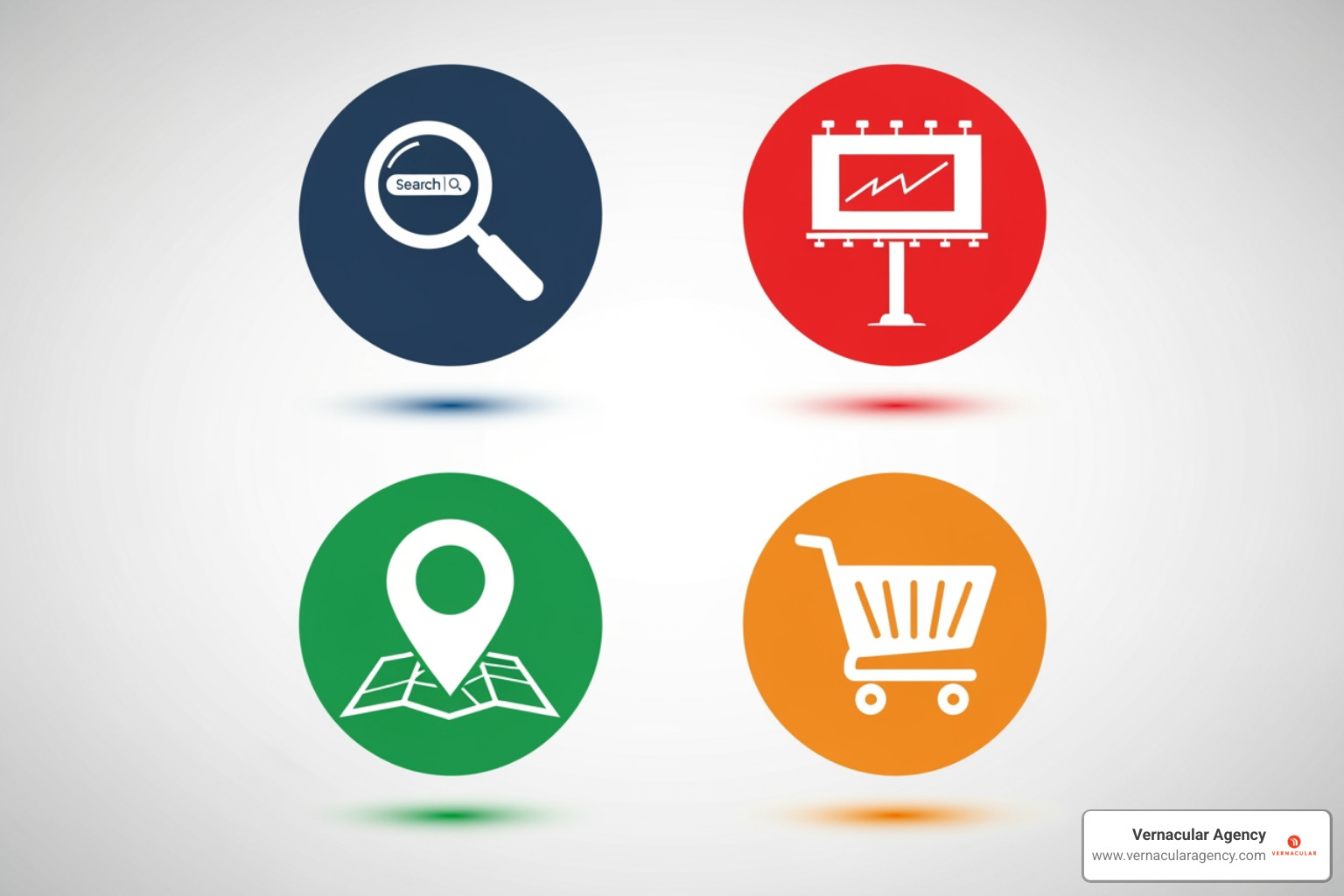
Search Campaigns: These are the most common and often the starting point for small businesses. Your text ads appear on Google search results pages when someone searches for keywords you've targeted. They're ideal for capturing high-intent users actively looking for your product or service. For example, a search ad for "heating repair Augusta Maine" directly targets someone with an immediate need.
Call Campaigns: If your business thrives on phone calls (like a local plumber, electrician, or real estate agent in Maine), Call Campaigns are a game-changer. These ads appear primarily on mobile devices and feature a prominent "Call" button, allowing users to dial your business directly from the search results. This eliminates extra clicks and gets potential customers on the phone with you faster.
Performance Max Campaigns: This is Google's newest, AI-powered campaign type. It allows advertisers to drive better results across all of Google’s advertising channels and inventory – Search, YouTube, Display, Find, Gmail, and Maps – from a single campaign. Performance Max combines AI with your goals and inputs to ensure your ads reach the right audience at the right time. For businesses looking for a comprehensive, automated approach to scale their reach, exploring Performance Max campaigns can be highly beneficial.
For many small businesses in Maine, local customers are your bread and butter. Google Ads offers powerful tools to connect with people in your immediate area.
46% of all Google searches are looking for local information, and 72% of local searchers will visit a business within five miles from them. This makes local targeting indispensable for a Google Ads small business strategy. Our expertise as a Digital Marketing Agency Portland Maine focuses on connecting you with these high-intent local customers.
Service-based businesses, from architecture firms to plumbers, have unique needs. Google Ads, particularly Search and Call campaigns, can be incredibly effective for generating high-quality leads. Here's a quick overview of how Google Ads supports service businesses:
| Feature | Google Ads (PPC) |
|---|---|
| Cost Model | Pay-Per-Click (PPC) – you pay when someone clicks your ad. |
| Best For | Capturing users with specific needs, building brand awareness, driving website traffic, generating calls or forms. |
| Targeting | Highly customizable: keywords, demographics, location, devices, ad scheduling. |
| Trust Signals | Well-crafted ads, positive reviews on landing page, strong website experience. |
| Management Effort | Requires ongoing keyword research, ad copy optimization, bid management, and landing page refinement. |
Google Ads allows you to reach customers in Maine when they're actively searching for the services you provide. Whether it’s an architect, a landscaper, or a consultant, we can tailor campaigns to attract high-value leads. For more in-depth information, you can Learn more about Google Ads for services.
Launching your Google Ads small business campaign is just the beginning. The real magic happens with ongoing management and optimization. Think of your Google Ads account like a garden: it needs regular tending to flourish. This continuous effort is why many businesses partner with us for Google Ads Management.
Optimization is about making small, incremental changes that lead to significant improvements over time. It's not a "set it and forget it" approach; it's a dynamic process driven by data.
To truly understand the impact of your Google Ads small business efforts, robust measurement is essential.
Key Metrics to Track:
Even with the best intentions, small businesses often stumble with Google Ads. Here are some common pitfalls and how we help you steer clear:
We often hear similar questions from small business owners in Maine who are considering or already using Google Ads. Here are some of the most common ones:
There's no one-size-fits-all answer here, but the good news is that with Google Ads, you decide how much money you can afford to spend. You set a daily budget, and Google ensures you never exceed your monthly cap. We recommend starting with a modest daily budget that allows you to gather meaningful data (typically enough for 20-30 clicks per day, depending on your industry's cost-per-click) and then scaling up as you see conversions. The key is to spend enough to learn and optimize, not to break the bank.
Absolutely! This is one of the most empowering aspects of Google Ads for small businesses. While larger companies might have bigger budgets, Google's auction system heavily favors relevance and ad quality (your Quality Score) over just bid amount. By focusing on highly specific keywords, crafting compelling ad copy, ensuring excellent landing page experiences, and diligently using negative keywords, your Google Ads small business can effectively compete for top ad positions and acquire customers, even against bigger players. It's about working smarter, not just spending more.
As mentioned, the average small-to-medium sized business can expect to make $8 in profit for every $1 they spend on a well-run Google Ads campaign. This is a fantastic benchmark! However, a "good" ROI can vary by industry and business goals. For some, a 2:1 or 3:1 ROI might be excellent if the customer lifetime value is high. For others, a 5:1 or higher is expected. We work with our clients to define realistic ROI targets based on their specific business model and market, continuously striving to maximize their return.
For small businesses in Maine and across the USA, Google Ads small business strategies offer an unparalleled opportunity to connect with customers precisely when they need you most. It's a powerful tool for lead generation, brand awareness, and driving measurable ROI, helping you compete effectively in today's digital world.
The path to success involves clear goal setting, meticulous keyword research (including the essential negative keywords), compelling ad and landing page creation, and continuous optimization based on data. It's a journey, not a destination, but one that promises significant rewards when steerd strategically.
At Vernacular Agency, we specialize in helping businesses like yours harness the full potential of Google Ads. We bring our expertise in crafting dynamic brand identities and strategic marketing to ensure your campaigns are not just running, but thriving. If you're ready to transform your digital presence and drive sustainable growth, take the next step in your marketing campaign strategy management with us.