
A website design architect is a professional who combines web design, user experience, development, and strategy into one unified role — treating your website the way a building architect treats a structure: with intention, precision, and long-term thinking.
Here's a quick breakdown of what that means in practice:
| Role Element | What It Does for Your Site |
|---|---|
| Web Designer | Creates the visual look and feel |
| UX/Interaction Designer | Ensures visitors can navigate easily |
| Web Developer | Builds the technical foundation |
| Strategist/Consultant | Aligns the site with your business goals |
Together, these roles form a single, cohesive approach to building websites that work — not just look good.
For architecture firms, this matters more than most. Your website is your portfolio, your pitch, and your first impression — often all at once. A site that loads slowly, looks outdated, or buries your best projects is quietly costing you clients.
The good news: getting it right doesn't have to be overwhelming. This guide walks you through exactly how a website design architect thinks, what the process looks like, and what to expect at every stage.
I'm Rebecca Falzano, Creative Director with nearly 15 years of experience shaping visual stories for brands across New York City and Maine — including helping firms think through how a website design architect approach can transform their digital presence. Let's start from the beginning so you know exactly what you're working with.
Easy website design architect word list:
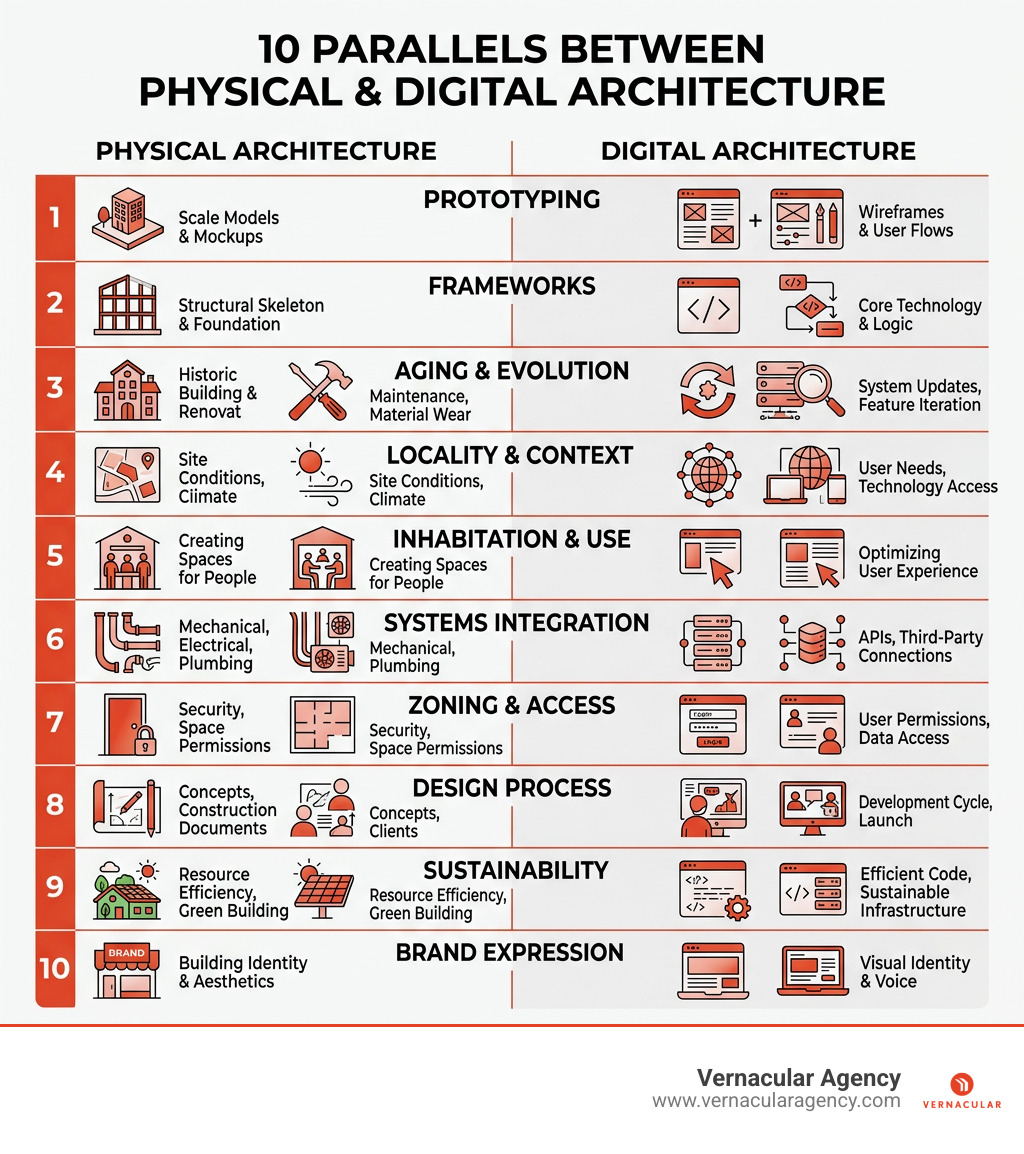
When you design a building, you don't just pick a pretty paint color and hope the roof stays up. You consider the foundation, the flow of traffic, the local zoning laws, and how the materials will age over thirty years. A website design architect applies this exact same rigor to your digital presence.
In architecture firm websites, "decoration" is the enemy of "structure." Many firms fall into the trap of building a site that looks like a beautiful art gallery but functions like a maze. A digital architect ensures that your information architecture is sound, meaning your potential clients can find your "Contact" page as easily as they can admire your latest skyscraper project.
By viewing Web design as architecture, we move away from temporary "marketing pages" and toward digital infrastructure. This means building strategic systems that generate revenue, attract top-tier talent, and serve as a cultural artifact of your firm's values.

One of the most powerful concepts in website architecture is the idea that websites are "prototypical." As the renowned architect Rem Koolhaas has suggested, websites are essentially "editions of one." Unlike a mass-produced product, every high-end architecture website is an experimental, non-serial project.
When we prototype a site, we aren't just making a mock-up; we are testing a thesis. How does the user move through a project gallery? Does the transition between a residential portfolio and a commercial one feel seamless? By treating the site as an experimental prototype, we allow for the kind of bold imagination that defines the best physical architecture.
The "magic" happens where front-end architecture meets visual impact. A website design architect must be part designer and part engineer. You need the technical precision to ensure the site doesn't break on a Safari browser in 2026, but you also need the "design eye" to ensure the typography reflects your firm's sophistication.
Usability consulting is at the heart of this balance. It’s about reconciling the beauty of a minimalist interface with the functional constraints of web accessibility. If you're curious about how to showcase your work without sacrificing speed, check out our Architecture Portfolio Website guide.
Digital architecture isn't just about what sits on the screen; it’s about the invisible frameworks that support it. Just as physical buildings must comply with zoning laws and building codes, websites must navigate the "zoning laws" of the internet—things like Google’s ranking algorithms, browser compatibility, and data privacy regulations.
Websites are also cultural artifacts. They are local, even if they are served globally. A firm based in Portland, Maine, should have a digital "locality" that feels different from a firm in Tokyo. This is achieved through "inhabitation"—how users live within and interact with your digital space. For a deeper dive into these conceptual parallels, the Are.na channel on web architecture is a fantastic resource, or you can see these principles in action by browsing the Best Architecture Firm Websites.
Performance is the "structural integrity" of the web. Did you know that 52% of website views now happen on a smartphone? If your site takes ten seconds to load a high-res rendering of a new library, you’ve already lost half your audience.
A website design architect focuses on speed optimization and mobile responsiveness from day one. This isn't just a "nice to have"—it's a core requirement. We use "performance stacks" to ensure that your site is lightweight, fast, and stable, even when it’s packed with heavy imagery. For more on this, read our Architecture Site Design tips.
Buildings decay, and so do websites. Links break, security vulnerabilities emerge, and content becomes stale. A digital architect plans for "graceful aging."
Standard maintenance shouldn't be a chore. With a well-built system, updates only take a few minutes a month. However, neglecting security patches can lead to disaster. We aim for 99.9% uptime and proactive monitoring to ensure your digital home stays upright. For a full roadmap on keeping your site healthy, see our Architecture Firm Website Complete Guide.
Building a website with a website design architect follows a structured workflow, much like a construction project. It starts with a creative brief (the "discovery" phase) and moves through wireframing, development, and rigorous QA testing before the final deployment.
| Feature | Basic Package | Pro Package | Premium Package |
|---|---|---|---|
| Typical Page Count | 1–5 Pages | 6–15 Pages | 15+ Pages |
| Timeline | ~2 Weeks | 3–5 Weeks | 8–16 Weeks |
| Focus | Essential Presence | Growth & SEO | Custom Enterprise |
| Best For | Solo Architects | Established Firms | Multi-disciplinary Agencies |
Before you start picking out fonts, you need to see some Architecture Portfolio Site examples to understand what’s possible within your scope.
Your website is a tool for lead generation. To make it effective, we start with keyword research. What are your potential clients actually typing into Google? Is it "modern residential architect in Maine" or "sustainable commercial design"?
Search Engine Optimization (SEO) is built into the very foundation of the site, not tacked on at the end. By optimizing for conversions, we ensure that a visitor doesn't just look at your photos—they click "Get in Touch." You can find more Architecture Web Design Company insights on how to turn traffic into actual projects.
For architects, the brand is the essence of the work. We integrate your logo, typography, and color palette to create an emotional connection with the viewer. The goal is to make your digital presence feel like an extension of your physical office. Whether it’s through refined typography or thoughtful white space, every pixel should reflect your firm’s brand. Learn more about Website Design for Architects and Engineers to see how we bridge the gap between technical skill and brand identity.
The next frontier for the website design architect is AI Optimization (AIO). Today, people don't just find you through Google; they find you through AI assistants and discovery platforms. AIO ensures that your brand is accurately represented and "cited" by these AI tools.
We are also seeing a move toward sustainable digital design—inspired by concepts like "mass timber" construction. This means building "single-file" applications that are incredibly efficient, reducing the energy required to load the site while maximizing speed. These Great Architecture Websites are already leading the way in this "less is more" digital philosophy.
The timeline depends on the complexity of your portfolio. A standard 5-page site can be ready in about 2 weeks. However, a more robust 15-page site typically takes 3 to 5 weeks. For large-scale firms with decades of projects to archive, the process can extend to 16 weeks to ensure every detail is perfect. Check out our Architect Portfolio Design Guide for a detailed timeline.
Pricing usually scales with the size of the firm and the depth of the content. Basic packages for small firms often start around $1,499+ CAD, while comprehensive signature packages for growing practices range from $2,299+ to $10,500+. For large firms requiring custom e-commerce or extensive integrations, projects can range from $16,000 to $25,000. For firms in our neck of the woods, we offer specialized Web Development Portland Maine services with transparent, fixed pricing.
As mentioned, 52% of web traffic is on smartphones. If your site isn't responsive, you are essentially closing your office door to every second person who tries to visit. Mobile optimization ensures that your images are resized correctly and your navigation is "thumb-friendly." Don't miss our Architect Portfolio Design Tips for making your mobile site shine.
At Vernacular Agency, we believe that your digital presence should be as enduring as the buildings you design. We don't just build websites; we create dynamic brand identities and SEO-optimized digital homes that support your firm’s long-term stability.
Based in Portland, Maine, we specialize in helping firms in the USA and beyond find clarity in their digital strategy. From brand definition to media placement, we provide the architectural oversight your website deserves.
Ready to build something that lasts? Start your web development journey with us today and let's design a site that works as hard as you do.