

Content creation and copywriting are two distinct disciplines — but they're constantly mixed up, even by experienced marketers.
Here's the quick answer:
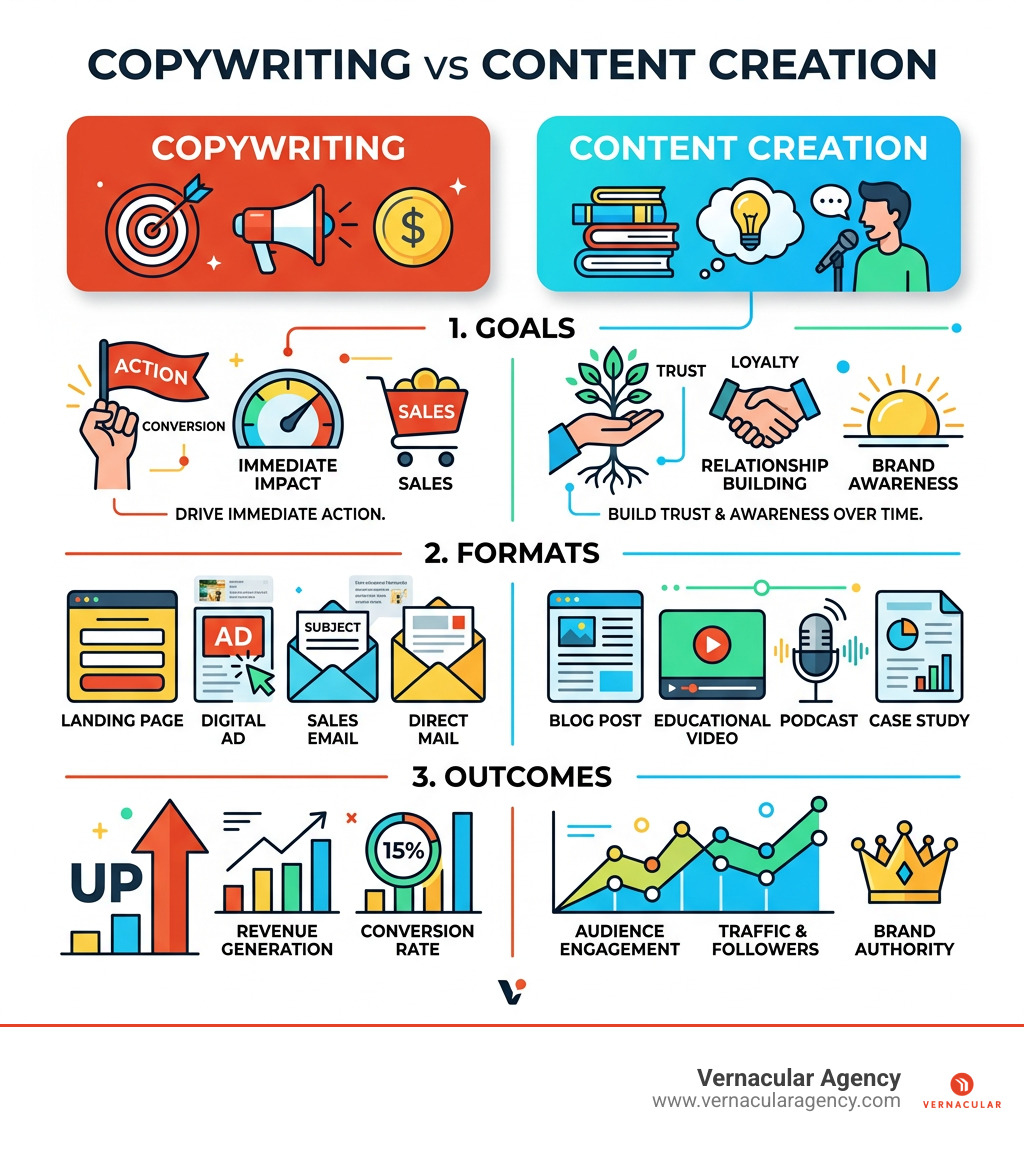
| Copywriting | Content Creation | |
|---|---|---|
| Goal | Drive immediate action (clicks, sales, sign-ups) | Build trust, awareness, and loyalty over time |
| Tone | Punchy, persuasive, direct | Educational, informative, engaging |
| Examples | Ads, landing pages, sales emails | Blog posts, videos, case studies, podcasts |
| Measures success by | Conversions and revenue | Traffic, engagement, and brand authority |
They overlap. They complement each other. But they are not the same thing.
One common scenario: a business hires a writer to "do copywriting" — and gets blog posts. Or they bring on a content writer expecting sales pages. The result is wasted budget and underwhelming results.
Getting this distinction right matters more than ever. With 87% of B2B marketers using content marketing to generate leads, and copywriting remaining one of the most direct drivers of revenue, knowing which tool to reach for — and when — is a core marketing skill.
I'm Rebecca Falzano, Creative Director with nearly 15 years of experience as a shelter magazine editor and writer, guiding brands through the full spectrum of content creation and copywriting — from the first spark of an idea to a finished story that resonates. Understanding how these two disciplines work together (and apart) is something I've applied across hundreds of projects, and it's exactly what we'll break down here.
Related content about content creation and copywriting:
To understand the divide, we have to look at the history of the written word in business. Traditionally, copywriting was the domain of the "Mad Men" era — think catchy headlines on billboards and persuasive text in newspaper ads. The word "copy" literally refers to the text used in advertisements. Its job was simple: sell the product.
Content writing, on the other hand, is a more modern evolution. It grew out of the need for brands to provide value in the digital age. Instead of shouting "Buy Now!" content writers whisper, "Let me help you solve this problem."
In our SEO Consulting work here in Maine, we often see that businesses struggle because they use the wrong tool for the job. Just like you wouldn't hire a plumber to fix a leaky roof, you wouldn't hire a storyteller to write a high-stakes sales page without ensuring they understand the psychology of conversion.
The fundamental difference lies in the aim.
The "vibe" of these two styles is worlds apart. Copywriting is often punchy, urgent, and one-directional. It speaks directly to the reader's pain points and offers a singular solution. It’s the "Hey, look at this!" of the marketing world.
Content writing is multi-directional and conversational. It invites the reader to learn, explore, and stay a while. It’s often longer, more detailed, and focuses on "tangential" topics. For example, a travel company might write a detailed guide on "How to stay healthy while flying" (content) rather than just a "Book your flight now" ad (copy). The content version builds trust so that when the reader is ready to book, that brand is the first one they think of.
In the modern marketing landscape, the lines are blurring. Why? Because effective content marketing process requires both. You can have the most educational blog post in the world, but if it doesn't have a persuasive Call to Action (CTA) at the end, you’re leaving money on the table. Conversely, you can have a great sales page, but if no one trusts your brand because you’ve never provided free value, they won't buy.
Statistics show that 87% of B2B marketers successfully use content marketing to generate leads. This success happens at the intersection of lead generation (copywriting) and demand generation (content creation).
When we talk about content creation and copywriting in the context of SEO, we have to talk about Google’s EEAT (Experience, Expertise, Authoritativeness, and Trustworthiness). Google’s core updates remind us that high-quality, satisfying content is the only way to rank long-term.
For specialized fields, such as Architectural Content Writing, this is vital. An architect doesn't just need a "Hire Me" button; they need deep-dive articles that showcase their design philosophy and technical knowledge. This builds the "Expertise" and "Trustworthiness" that search engines crave.
A business that only does copywriting feels "salesy" and cynical. A business that only does content creation becomes a "starving artist" — lots of fans, but no revenue.
You need both to navigate the customer journey:
Our Content Creation Services focus on this holistic approach. We don't just write words; we build bridges between your brand and your future customers.
What does this actually look like on your "To-Do" list? The deliverables for each discipline require different mindsets and structures.
When you look at Branding and Content Creation, you see that the best brands maintain a consistent voice across all these formats. Whether it’s a 3-word ad or a 3,000-word guide, it should feel like it's coming from the same "person."
We can’t talk about content creation and copywriting today without mentioning AI. Tools like ChatGPT and various generative AI platforms have revolutionized the industry. According to recent surveys, 61.4% of marketers have used AI in their campaigns, and 44.4% use it specifically for content creation.
However, there’s a catch. While AI is great for overcoming "blank page syndrome," it often lacks the soul, empathy, and strategic nuance of a human writer. Google’s Search Essentials make it clear: the focus must remain on delivering a high-quality experience for humans.
In copywriting, AI is a powerful tool for:
But remember, copywriting is about empathy. It's about knowing exactly what keeps your customer up at night. AI can mimic that, but it can’t feel it. A human editor is still essential to ensure the copy doesn't sound "robotic" or "douchey."
For content creation, AI helps with:
The danger here is "GTM Bloat" — flooding the internet with generic, AI-generated content that provides no real value. To stand out, brands need contrarian thought leadership and personal anecdotes that AI simply can't invent.
If you’re a writer or a business owner looking to hire, you might wonder which path is better. There isn't a "right" answer, but there are definitely different fits.
How do you decide?
For specialized industries, like Content Marketing for Architects, hiring someone who understands both the technical nuances of the field and the psychology of the client is the "cheat code" for success.
Absolutely. In fact, many of the best writers in the industry are "hybrids." However, most people naturally gravitate toward one. A journalist might find the transition to content writing easy but struggle with the "hard sell" of copywriting. A salesperson might write great copy but find long-form blog writing tedious. If you’re just starting, try writing both to see where your "personality fit" lies.
Generally speaking, copywriters often have a higher earning potential. This is because their work is directly tied to revenue. If a copywriter writes an email that generates $35,000 in sales, they can charge a premium or even work on a commission/retainer basis. Content writers are often paid flat rates based on word count or hours, though high-level content strategists can also command very high fees.
Look at your immediate goals. Do you have a "leaky" sales funnel where people visit your site but never buy? You need a copywriter. Do you have a site that no one visits because you have no helpful information? You need a content writer. If you’re building a brand from scratch in a place like Portland, Maine, you likely need a strategy that incorporates both from day one.
At the end of the day, content creation and copywriting are two sides of the same coin. One builds the house (content), and the other invites people in and asks them to stay (copy).
At Vernacular Agency, we specialize in "de-douchifying" the marketing process. We believe in authentic brand definitions and creative solutions that don't just fill space with words, but actually move the needle for your business. Whether you're looking for Content Creation & Creative Direction or a full SEO-optimized website, we help brands in Maine and beyond find their unique voice.
Don't let your marketing get lost in the buzzwords. Focus on value, focus on the user, and use the right writing discipline for the right goal. Ready to tell your brand's story? Let's get to work.