Why Brand Development Matters for Your Business Growth
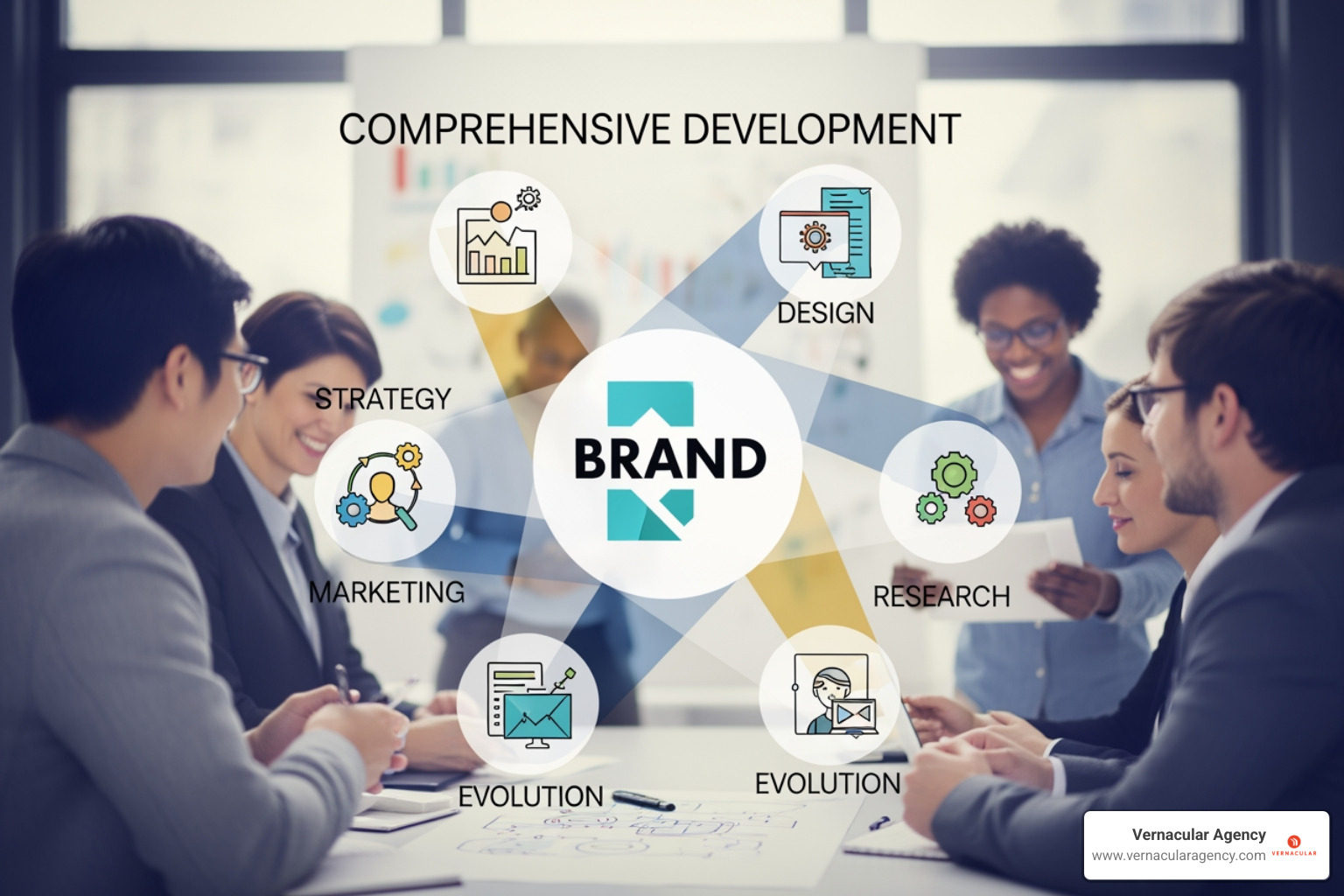
Comprehensive brand development is the strategic process of shaping your brand's identity to align with business objectives. It includes:
- Strategic Foundation: Vision, mission, and values.
- Brand Architecture: Relationship between products and sub-brands.
- Visual Identity: Logo, colors, and typography.
- Brand Messaging: Positioning and storytelling.
- Implementation: Guidelines for consistency.
- Measurement: Tracking performance.
Consistent brands see a 33% revenue increase. Your brand is the promise you make to customers. As your business grows, this process ensures your identity evolves without losing its core. I'm Rebecca Falzano, Creative Director at Vernacular Agency, with 15 years of experience guiding brands from strategy to execution.
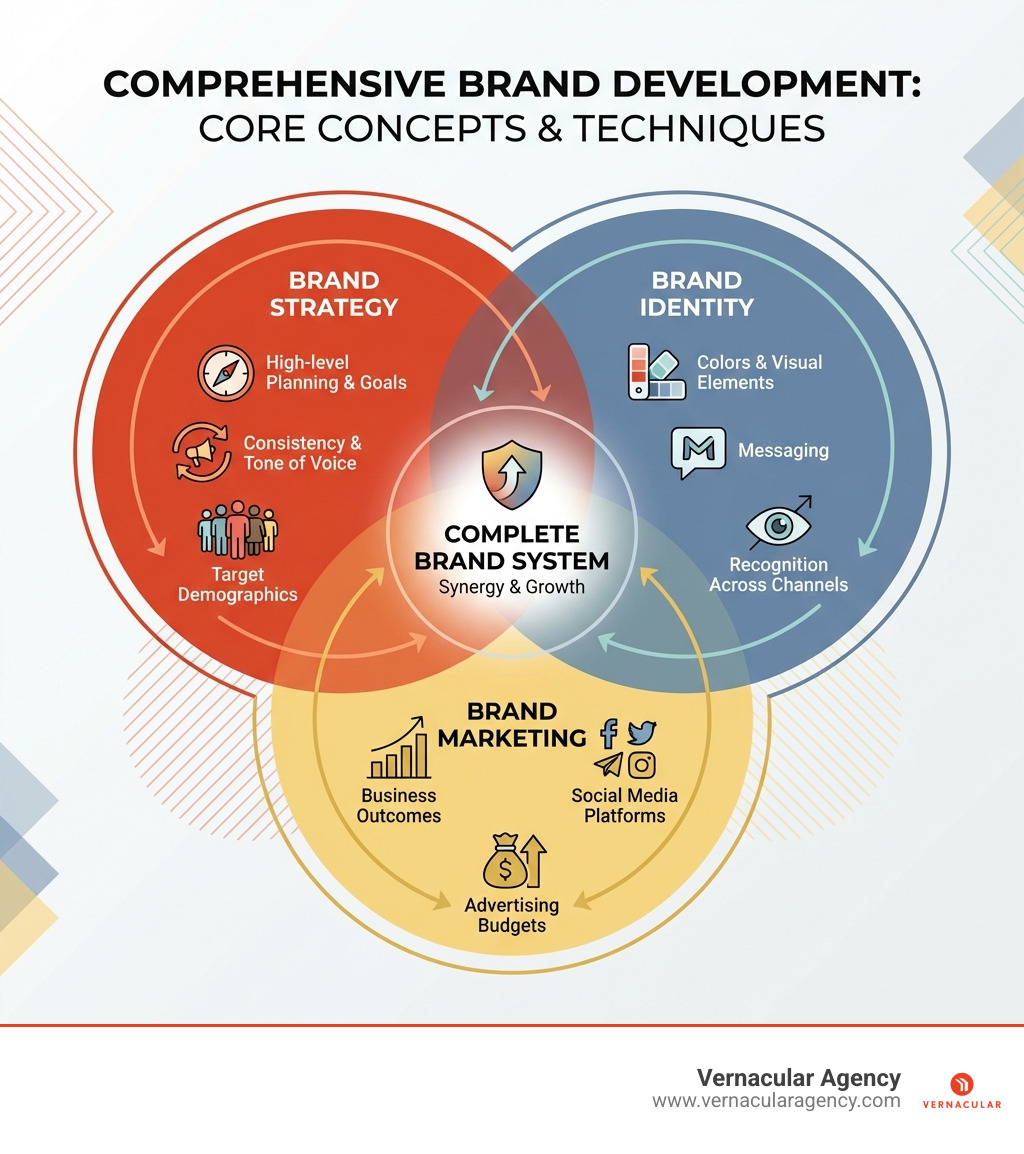
The Strategic Foundation of Brand Equity
A strong brand is built on vision, mission, and values. These guide every decision, from product design to customer service.
- Vision: Your aspirational future.
- Mission: Your daily actions.
- Values: Your operating principles. Leadership must model these to ensure internal alignment.
- Identity: Your core essence.
Authenticity is vital; 86% of consumers prioritize it. When we perform Professional Brand Development, we help Maine businesses articulate a purpose that resonates. This research-driven approach ensures brand building and performance marketing can work together for maximum impact.
The Roadmap to Comprehensive Brand Development
Our 8-step framework ensures a robust brand:
- Business Strategy: Aligning brand with objectives.
- Target Audience: Using user persona templates to understand needs.
- Competitive Landscape: Finding your unique niche.
- Brand Architecture: Organizing your portfolio.
- Messaging Strategy: Crafting resonant messages.
- Website Alignment: Essential for Website Design for Architects.
- Content Marketing: A key part of Branding and Content Creation.
- Optimization: Using an analysis dashboard template to track success.
Defining Architecture
Brand architecture manages multiple offerings. Options include Branded House (LEGO), House of Brands (Newell), or Hybrid (Fiat). We use a brand strategy planning template to ensure scalability.
Crafting Identity
At Vernacular Agency, we create Brand Identity systems including:
Messaging and Storytelling Strategies
Messaging connects your identity to your audience.
Measuring Impact and Mitigating Risks
Brand Development vs. Brand Management
| Aspect | Brand Development | Brand Management |
|---|
| Focus | Strategic, long-term identity shaping | Operational, day-to-day maintenance |
| Goal | Build and differentiate foundation | Preserve and improve brand equity |
| Activities | Research, architecture, identity design | Campaign execution, monitoring, CX |
| Outcome | Differentiated strategy and identity | Consistent presentation and loyalty |
Measuring Success
We track KPIs like Brand Awareness, Customer Loyalty (NPS), Perception (via brand perception surveys), and Revenue Growth.
Mitigating Risks
The Strategic Foundation of Brand Equity
At the heart of any successful business lies a strong brand, and at the core of that brand are its fundamental principles: vision, mission, and values. These aren't just feel-good statements; they are the bedrock upon which all comprehensive brand development is built, guiding every decision, from product design to customer service.
Let's break down these core elements:
- Vision: Your "Why"Our vision is the bold, aspirational future we're striving to create. It's the long-term view, the ultimate impact we want to make. Think of it as our North Star, guiding our journey and motivating our team. It should be clear and courageous, not a watered-down buzzword.
- Mission: Your "How"Our mission defines what we do right now to pursue that vision. It's grounded in action, detailing our current efforts and how we bring our vision to life daily. This is our purpose in motion.
- Values: Your "How You Behave"Our values are the behaviors, beliefs, and operating principles that guide our decisions, teamwork, and interactions. They are not just words on a wall but actual practices that shape our internal culture and external presence. As Lindsay Pedersen, a brand strategist, emphasizes, "Brand strategy is a business strategy and will only be carried out insofar as all employees see the CEO model the brand, not just when it’s easy, but especially when it’s hard." This means leadership must embody these values for them to truly permeate the organization.
- Identity: Your "What"Our identity is how we describe ourselves at our core—articulating our function, ethos, and what makes us different. It's the concise summary of who we are and what we stand for.
These elements, when clearly defined, make everything else easier: our messaging, our hiring, our design, and our leadership. They form the core of a successful brand development strategy.
Why is this strategic foundation so crucial for business growth? Because brand is about relationship, not just image. Consumers today are savvier than ever, and authenticity matters deeply to them. In fact, 86% of consumers say authenticity is a key factor when deciding which brands to support, and 82% buy from brands with a greater mission or purpose. A strong brand purpose helps build customer loyalty and fosters long-term success. For instance, companies like Zappos famously invest heavily in internal culture and brand training, ensuring every employee delivers on their customer service promise, aligning their internal operations with their brand's external identity. This dedication to internal alignment creates a consistent and positive brand experience for customers.
When we engage in Professional Brand Development, we start by delving deep into these foundational questions. We help businesses in Maine and beyond articulate their unique vision, mission, and values, translating them into a compelling brand purpose that resonates both internally and externally. This isn't just about crafting pretty words; it's about uncovering the truth of who you are and building a brand that truly reflects it. The more research we put into understanding these fundamentals, the more effective our brand building becomes, aligning closely with scientific research on how brand building and performance marketing can work together for maximum impact.
The Roadmap to Comprehensive Brand Development
Starting on a journey of comprehensive brand development requires a clear roadmap, a structured approach that moves from initial concept to ongoing refinement. It's not a shot in the dark; it's a strategic process designed to create a brand that not only looks good but also performs brilliantly for your business.
Our approach to brand development typically follows a structured, multi-step process, ensuring no stone is left unturned. This process aligns with the 7-step brand development framework often cited in the industry:
- Consider Business Strategy: Our brand strategy starts as an extension of your business strategy. We clarify your overall business objectives and how the brand will support them.
- Know Your Target Audience: High-growth, high-profit firms are laser-focused on their target clients. We conduct extensive audience research, going beyond basic demographics to explore psychographics, needs, pain points, and aspirations. Creating detailed user persona templates helps us bring your ideal customers to life, guiding our brand image and messaging. The more precisely we understand your audience, the more effectively we can connect with them.
- Map the Competitive Landscape: We perform thorough competitor analysis to identify how others position themselves. This helps us find your unique niche and capitalize on any market inefficiencies or underserved sectors. This step is crucial for developing a brand that truly stands out in competitive markets.
- Develop Brand Architecture: We define how all your brands and their various components work together, ensuring a cohesive branding experience. This leads us to the next section...
- Create Brand Messaging Strategy: Once we know who we are (our identity) and who we're talking to (our audience), we craft messages that resonate. This is where we determine how we convey our brand effectively, which we’ll explore further.
- Ensure Website Reflects Brand: Your website is often the first impression customers have of your brand in the digital age. We ensure it's a model example of your brand, communicating your message effectively and generating leads. This is particularly important for services like Website Design for Architects, where visual identity and user experience are paramount.
- Ensure Content Marketing is Top-Notch: Content marketing is a powerful tool for building both reputation and visibility. We develop content strategies that align with your brand messaging and address your audience's needs. Given that 91% of B2B marketers use content marketing, it’s an essential component of Branding and Content Creation for businesses today.
- Measure Brand Reception and Optimize: Our work doesn't stop at launch. We continuously monitor how your brand is received, track key metrics, and make adjustments as needed. This ongoing performance measurement is vital for long-term success. An analysis dashboard template can be instrumental in visually reporting key metrics and performance to gain quick insights.
This comprehensive roadmap ensures that every aspect of your brand is strategically considered and executed, leading to a robust and impactful presence.
Defining Architecture for Comprehensive Brand Development
When we talk about comprehensive brand development, we often encounter businesses with multiple products, services, or even distinct sub-brands. This is where brand architecture comes into play – it's the organizational structure of your brand portfolio, mapping out how all your brands and their various components work together to ensure a cohesive experience for your target audience(s).
A well-defined brand architecture is crucial for scalability, especially for growing businesses. It clarifies relationships between offerings, prevents market confusion, and allows for efficient resource allocation as you expand into new markets or launch new products. It ensures that your brand development strategy can enable scalability without diluting your core identity.
There are generally three main types of brand architecture:
- Corporate Brand Architecture (Branded House): This approach uses a single, dominant brand name across all products and services. The corporate brand is the primary driver of equity, and extensions leverage its reputation. A classic example is LEGO, with its various lines like LEGO Ninjago or LEGO Friends, all clearly under the LEGO umbrella. This approach builds strong master brand equity and simplifies marketing.
- Product Brand Architecture (House of Brands): Here, the parent company owns a portfolio of independent brands, each with its own distinct identity and market positioning. The parent brand may be invisible to the consumer. Newell, for instance, is the parent company for a diverse range of brands like Yankee Candle, Crock-Pot, and Sharpie, each targeting different consumers and needs. This allows for targeting diverse market segments without diluting the core brand.
- Endorsing Brands (Hybrid): This model combines elements of both, where sub-brands have their own identity but are clearly associated with a master brand that lends credibility and endorsement. Fiat Group, for example, is the master brand endorsing Ferrari, Alfa Romeo, Chrysler, and Dodge. This offers a balance of individuality and credibility.
Choosing the right brand architecture is a strategic decision that depends on your business goals, target markets, and long-term vision. We use a brand strategy planning template to help clarify these relationships and ensure that your brand family grows in a coherent and powerful way, strengthening your overall market positioning.
Crafting Identity for Comprehensive Brand Development
Our visual and verbal identity is how we present ourselves to the world, and it's a critical component of comprehensive brand development. It's the tangible expression of our brand, creating recognition, fostering trust, and helping us stand out in competitive markets. What constitutes a strong brand identity, and how is it practically expressed? It's a full suite of assets, consistently applied.
At Vernacular Agency, we specialize in creating dynamic Brand Identity systems that captivate and communicate. Here's what goes into crafting a strong identity:
- Logo Design: Our logo is often the visual cornerstone of our brand. It should be scalable, recognizable, and versatile across all applications, from a tiny social media icon to a large billboard. Memorable logos are 13% more likely to get consumer attention and 7% more likely to make brands appear trustworthy. For specialized industries like architecture, a distinctive Logo Design for Architects can convey professionalism and creativity.
- Color Palette: Colors evoke specific emotions and associations. Color increases brand recognition by up to 80%! We carefully select a corporate color palette, complete with specific Pantone, CMYK, and RGB values, and often complementary additional color options. This ensures consistency across all materials, whether digital or print.
- Typography: The fonts we choose communicate tone and personality. Good typography matches our brand personality, maintains legibility across devices, and works for both headlines and body text. A staggering 75% of consumers judge a brand’s credibility based on its website design, including typography.
- Brand Voice and Tone: Just like a person, our brand has a specific voice. Developing an authentic brand voice involves defining 3-5 key personality traits and documenting them. A brand voice template can help us select adjectives that describe how our brand sounds and speaks. This ensures that whether we're writing an email or a social media post, our communication is consistent and recognizable.
- Imagery Style: We don’t need to use the exact same photos repeatedly, but all imagery—be it photos, illustrations, or graphics—should have a consistent look and feel. The human brain processes images 60,000 times faster than text, so visual consistency is paramount!
- Brand Guidelines: To ensure consistency across all touchpoints, we create comprehensive brand guidelines. These act as a style guide, codifying our brand essence and providing clear instructions for logo usage, color specifications, typography, photography style, graphic treatments, and tone of voice. A brand visual identity checklist helps ensure all elements are covered.
By carefully crafting and consistently applying these identity elements, we build a powerful brand image that cultivates the reputation we desire with our audience. This allows our business to stand out in competitive markets, making an immediate and lasting impression.
Messaging and Storytelling Strategies
Once we've laid the strategic foundation and crafted a compelling identity, the next crucial step in comprehensive brand development is to articulate who we are and what we offer through powerful messaging and storytelling. This is how we connect with audiences on a deeper level, building relationships that foster lasting customer loyalty.
- Unique Value Proposition (UVP) and Positioning Statement:Our messaging journey begins with defining our Unique Value Proposition (UVP). This specifically articulates how our product or service is the best at solving our ideal customer’s problem. It’s what makes us different and why customers should choose us. With a firm grasp of our UVP, we then craft a positioning statement. This internal document helps our marketing team craft messaging that clearly communicates our differentiation to our target audience. As one expert states, the more differentiated your UVP is, the more successful your brand will be. We use tools like a unique value proposition guide to hone this critical element.
- Brand Messaging Components:Brand messaging answers the fundamental question: "How do we convey our brand to our target audience?" It involves translating our brand identity and buyer personas into key messages across all communication channels. This includes:
- Taglines: Short, memorable phrases that capture our essence.
- Messaging Pillars: Core themes or ideas that consistently reinforce our UVP and values.
- Tone of Voice Guidelines: Ensuring our communication style is consistent and aligns with our brand personality.Companies that invested in message mapping saw improved customer engagement by 71%, highlighting the power of clear and consistent messaging.
- The Power of Brand Storytelling:Humans are wired for stories. That's why 92% of consumers want brands to create ads that feel like stories. Brand storytelling is a narrative that combines facts about our brand and products while evoking emotion in our audience. It's about sharing our origin, purpose, values, and the journey we're on. The "Building a StoryBrand" framework, for example, outlines a powerful narrative: your customer is the hero, facing a problem. Your brand acts as the guide, offering a plan and a call to action, leading them to success and helping them avoid failure. This simple, authentic formula can be used to craft compelling narratives that resonate. We use a brand story template to structure these narratives effectively.
- Mapping the Customer Journey:To deliver our messaging and storytelling effectively, we map the customer journey. Using our buyer persona, we detail their purchasing journey from start to finish, understanding their functional and emotional needs at each stage. A customer journey map template helps us identify "moments of truth" – instances where customers interact with our brand and impressions are shaped. This allows us to tailor our messaging and ensure a consistent, compelling brand experience that drives lasting customer loyalty. For example, Trader Joe's has built its business around clear promises and a friendly shopping experience, guiding all marketing efforts and fostering deep loyalty.
By developing a coherent narrative and consistent messaging, we don't just sell products or services; we invite customers into our brand's world, fostering emotional connections and building a loyal community around our shared values.
Measuring Impact and Mitigating Risks
Even the most carefully crafted comprehensive brand development strategy isn't complete without a robust system for measuring its impact and mitigating potential risks. It's a continuous cycle of planning, execution, assessment, and adaptation.
What is the difference between brand development and brand management?
This is a critical distinction to understand. While often used interchangeably, they represent different phases and focuses:
| Feature | Brand Development
| Aspect | Brand Development | Brand Management |
|---|
| **Focus** | Strategic, long-term, shaping identity, defining purpose, creating core elements | Operational, day-to-day, maintaining consistency, executing marketing, monitoring health |
| **Goal** | Build, evolve, and differentiate the brand; establish its foundation and direction | Preserve, protect, and improve brand equity; ensure consistent delivery of brand promise |
| **Activities** | Market research, audience analysis, vision/mission/values definition, brand architecture, identity design, messaging strategy, storytelling | Campaign execution, brand guideline enforcement, asset maintenance, brand monitoring, reputation management, customer experience consistency |
| **Outcome** | A clear, compelling, and differentiated brand strategy and identity | Consistent brand presentation, strong brand equity, customer loyalty, and positive brand perception |
How can businesses measure the success and impact of their brand development efforts?
Measuring the success of your comprehensive brand development efforts is crucial to understanding your return on investment and guiding future strategies. We track several key performance indicators (KPIs):
- Brand Awareness: How familiar is your target audience with your brand? We track metrics like website traffic, social media reach, brand mentions, and search volume for your brand name. Increased brand recognition by up to 80% with consistent use of color is a strong indicator of success.
- Customer Loyalty and Retention: Are customers returning? Are they advocating for your brand? Metrics include repeat purchase rates, customer lifetime value, and Net Promoter Score (NPS). A well-developed brand drives lasting customer loyalty, and strong loyalty means higher conversion rates and greater awareness.
- Brand Perception and Sentiment: What do customers think and feel about your brand? We use tools like a brand perception survey to collect data on how consumers describe your brand, monitor social media interactions, and analyze online reviews. This helps us understand if our brand is resonating as intended.
- Revenue Growth and Market Share: Brand development should contribute to the bottom line. We look at sales figures, market share changes, and the ability to command premium pricing. Companies that track brand metrics show 29% better performance in revenue growth.
- Brand Equity: This is the overall value of your brand over time as perceived by your target audience. It's built through consistent positive experiences and strong brand recognition.
What are the potential risks in brand development and how can they be mitigated?
Comprehensive brand development is a complex process with inherent risks that can undermine a company's efforts if not proactively addressed. Here are some potential pitfalls and how we mitigate them:
- Inconsistent Brand Identity:
- Risk: Failure to define brand identity clearly leads to inconsistent branding strategies and confusion among customers. Our brand, like a chameleon changing colors, loses its distinctiveness. Brands with inconsistent presentation across platforms can lose revenue.
- Mitigation: Develop comprehensive brand guidelines and ensure they are rigorously applied across all touchpoints. We regularly review and refine your brand identity to ensure it reflects your business's core values, building trust and loyalty.
- Misaligned Marketing Campaigns:
- Risk: Marketing campaigns that don't align with the established brand identity and values result in ineffective communication, wasted resources, and missed opportunities. It's like having a beautiful car but putting the wrong fuel in it.
- Mitigation: Ensure close collaboration between brand development and marketing teams from the outset. We implement an effective branding strategy that uses traditional and digital marketing channels to consistently communicate your brand’s message and values.
- Overlooking Existing Customers:
- Risk: Focusing solely on new customer acquisition can erode loyalty among existing customers, leading to lost sales and negative word-of-mouth. 76% of customers expect consistent interactions across departments.
- Mitigation: Implement strategies that nurture existing customers alongside efforts to attract new ones. Diversify your marketing channels and tailor your campaigns to meet the specific interests and preferences of different customer segments without compromising the attention given to loyal customers.
- Lack of Market Relevance:
- Risk: A brand that fails to adapt to changing market conditions or consumer preferences quickly becomes outdated and irrelevant.
- Mitigation: Stay adaptable in your marketing strategies, continuously assess the effectiveness of your approaches, and remain open to innovations in marketing practices. Conduct regular market research and use a brand strategy annual review template to adjust your strategy based on data and market shifts.
- Underused Distinctive Assets:
- Risk: Failing to leverage unique brand assets prevents a brand from truly standing out in a competitive market.
- Mitigation: Identify and amplify what makes your brand truly unique, ensuring these distinctive assets are integrated across all company activities, from customer service to product development. This integration helps reinforce your brand’s message internally and externally.
By understanding these potential risks and implementing proactive mitigation strategies, we help businesses build more robust and sustainable brands that can withstand the test of time and market changes.
Frequently Asked Questions about Brand Development
What is the difference between brand development and brand management?
Development builds the "house" (identity and strategy), while management handles the "upkeep" (consistency and marketing).
How does brand development align with marketing strategy?
Development defines the personality and tone, which then guides campaign execution and channel integration.
What are the critical questions to ask for effective brand development?
Focus on alignment with values, recognition strategies, market relevance, and holistic integration across all company activities.
Conclusion
Comprehensive brand development is the blueprint for success. For businesses in Maine, Vernacular Agency provides creative solutions from definition to media placement. Ready to secure your brand's equity? Start your comprehensive brand strategy.
