
Brand architecture strategy is the structural framework that defines how your company's brands, sub-brands, products, and services relate to each other — and to your customers.
Here's a quick overview of what it involves:
| Element | What It Means |
|---|---|
| Definition | The organizational system that governs your brand portfolio |
| Purpose | Creates clarity for customers and efficiency for your marketing |
| Core models | Branded House, House of Brands, Endorsed, and Hybrid |
| Key benefit | Protects brand equity and guides every naming and identity decision |
| Who needs it | Any business with more than one product, service, or sub-brand |
Think of brand architecture as the foundation of your business identity. Without it, growth creates chaos — overlapping product names, confused customers, and diluted brand value.
The stakes are real. Organizations with a clear brand architecture achieve 3.5 times more visibility than those without one. And roughly 25–40% of new products fail, often because customers simply can't understand how they fit into the bigger picture.
Whether you're launching a second product line, acquiring a competitor, or expanding into a new market, the decisions you make about brand structure shape everything — from how customers navigate your offerings to how efficiently your marketing budget works.
I'm Rebecca Falzano, Creative Director with nearly 15 years of experience crafting and communicating brand stories across industries — and brand architecture strategy sits at the heart of every project I lead. That experience informs everything you'll find in this guide, so let's build something that lasts.
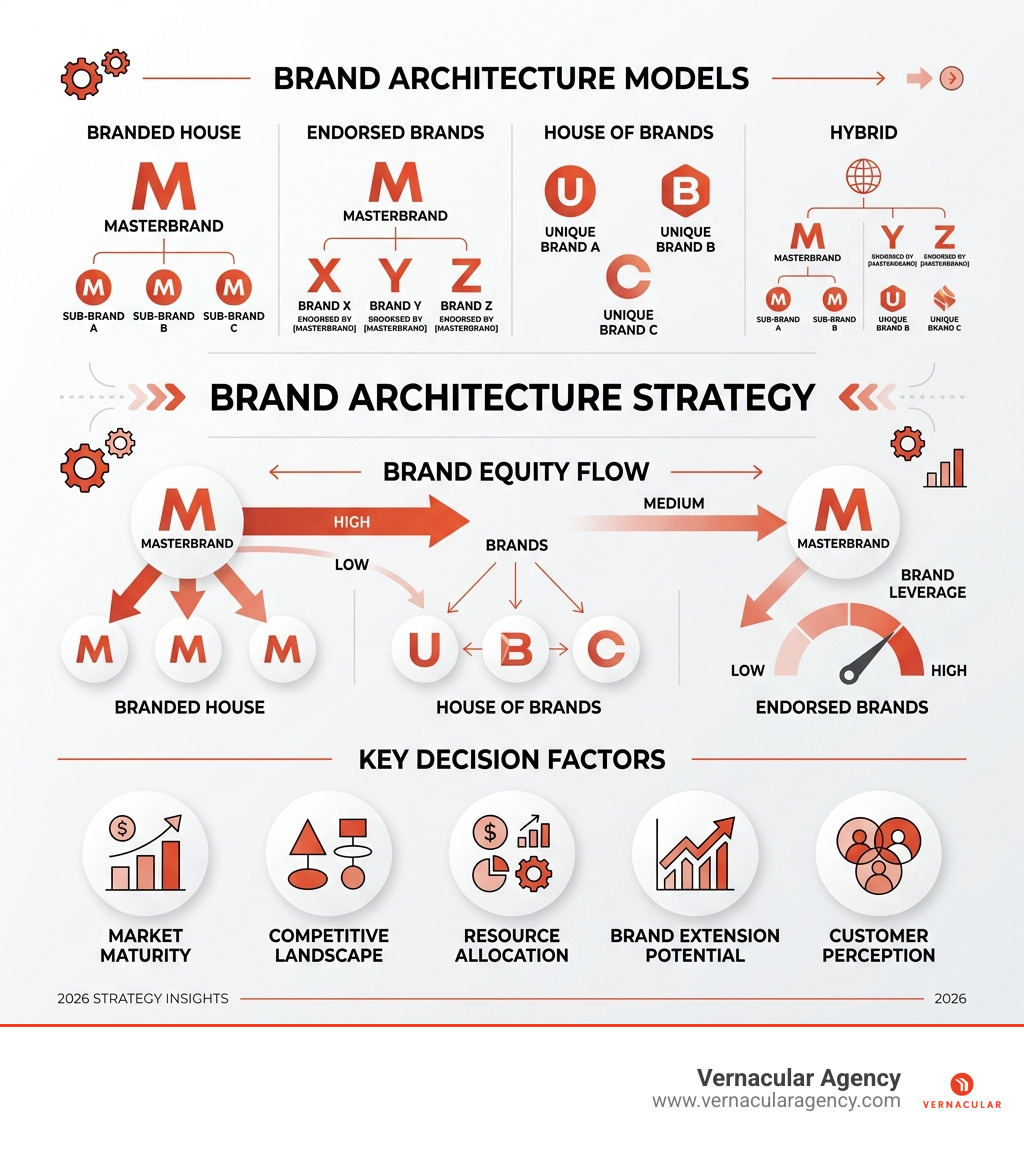
At its core, a brand architecture strategy is the "operating system" of your business identity. It specifies the blueprint for the interdependent relationships between a company’s brands. We often see businesses in Maine and across the U.S. struggle when they grow too fast without a plan. They end up with a "house" where the rooms don't connect, the hallways lead nowhere, and the guests (your customers) are hopelessly lost.
Why is this so crucial for your success? First, it governs equity transfer. Brand equity is the value premium that a company generates from a product with a recognizable name as compared to a generic equivalent. A well-defined architecture allows that hard-earned "goodwill" to flow from your established brands to your new ones, giving them an immediate head start.
Second, it solves the problem of customer navigation. When we Structure Brands with the Brand Architecture Framework, we make it easy for a buyer to say, "I love their software, so I’ll probably love their consulting services, too." Without this clarity, you risk brand dilution—where a brand is stretched so thin across too many categories that its meaning becomes blurry and less distinct.
From a Professional Brand Development perspective, efficiency is the name of the game. If you have a clear strategy, you aren't reinventing the wheel every time you launch a product. You know exactly how to name it, what colors to use, and how it should talk. This level of control protects your revenue; in fact, about 25% of companies with weak brand control estimate losses of $6 million to $10 million per year due to inconsistency. By investing in architecture, you are essentially buying "risk insurance" for your brand’s reputation.
Deciding how to organize your brands isn't a one-size-fits-all task. It depends on your business vision, your budget, and how much "family resemblance" you want your products to have. According to The Complete Guide to Brand Architecture - Qualtrics, there are four primary ways to build your house.
To help you visualize these, we’ve put together a comparison of the heavy hitters:
| Model | Relationship | Best For | Risk |
|---|---|---|---|
| Branded House | One master brand for everything | High efficiency and trust | Reputational spillover |
| House of Brands | Independent, unrelated brands | Diverse markets and risk isolation | Very high marketing costs |
| Endorsed | Sub-brands "brought to you by" parent | Balancing autonomy and trust | Brand confusion if overused |
| Hybrid | A mix of all of the above | Large conglomerates/M&A | Complexity and management friction |
Understanding driver roles is key here. The "driver" is the brand that primarily influences the customer's purchase decision. In some cases, it’s the parent company; in others, it’s the specific product. For a deeper look at how these look in the real world, check out our Branding and Identity Lookbook.
The Branded House (or Monolithic) model is the ultimate "one for all" approach. Here, the master brand is the star of the show. Think of Apple. Whether it’s a phone (iPhone), a watch (Apple Watch), or a service (Apple TV+), the Apple name is the primary driver of value. This strategy helped Apple become the first company worldwide to reach a $3 trillion market value.
Another classic example is FedEx. They use a consistent visual system where the "FedEx" name is always prominent, followed by descriptive sub-brands like Express, Ground, or Freight.
The Upside: It is incredibly efficient. You spend your marketing dollars building one massive brand. Every new product launch benefits from the existing Brand Identity and trust.The Downside: There is a high "spillover risk." If one product has a major failure or scandal, it can tarnish the entire house. It also makes it harder to target vastly different audiences—you wouldn't want a luxury brand and a budget brand sharing the exact same name. For those in specialized fields, our Architecture Firm Branding Ultimate Guide explores how this monolithic approach can build massive authority in a local market like Portland, Maine.
The House of Brands is the polar opposite. The parent company stays in the background (often invisible to the consumer), while the individual brands take center stage. Procter & Gamble (P&G) is the master of this, managing 65 individual brands—like Tide, Pampers, and Gillette—across 10 categories for 5 billion consumers. Most people buying Tide don't even realize it's owned by P&G.
The Upside: This model is perfect for market segmentation. You can own the "budget" detergent and the "premium" detergent in the same aisle, and they can compete with each other without the customer feeling conflicted. It also provides excellent risk isolation; if one brand fails, the others are safe.The Downside: It is expensive. Very expensive. You have to build, market, and maintain Branding and Identity Design Examples for every single brand independently. There is no "free ride" on the parent’s equity.
Sometimes, you need the best of both worlds. Endorsed branding allows a sub-brand to have its own unique personality while still carrying the "seal of approval" from a parent brand. Marriott does this beautifully. They have Courtyard by Marriott, Residence Inn by Marriott, and Fairfield by Marriott. The sub-brand tells you the price point and style, but the Marriott name provides the "credibility lift" that ensures quality.
The Hybrid model is often the result of growth through acquisitions. Amazon is a great example. They have a Branded House for things like Amazon Prime and Amazon Echo, but they also own standalone brands like Audible, Twitch, and Whole Foods. This gives them the flexibility to keep the equity of acquired companies while slowly integrating them into the ecosystem.
For a deeper dive into these nuances, see our Brand and Identity Design Complete Guide. These models are particularly popular for professional services; for instance, we often discuss Brand Identity for Architects who may want to endorse a new interior design sub-unit without losing the prestige of their main firm name.
Building a brand architecture strategy isn't just a creative exercise; it's a diagnostic one. If you’re feeling the "symptoms" of a messy brand—confused customers or internal teams that can't explain what you do—it’s time for a structured approach.
According to How to Develop an Effective Brand Architecture Strategy - HBS Online, here are the practical steps we recommend:
For firms in the design and build space, having clear Architecture Firm Brand Guidelines ensures that as you add partners or locations, the brand stays cohesive and professional.
Developing a brand structure often brings up a lot of "what ifs." Here are the questions we hear most often at Vernacular Agency.
The biggest red flag is customer confusion. If your sales team spends the first ten minutes of every call explaining how your different services relate to each other, your architecture is failing. Other signs include "internal friction"—where different departments are competing for the same customers—or declining core preference, where your master brand is losing its "spark" because it’s attached to too many low-quality extensions. Effective Branding and Content Creation can't fix a broken structure; you have to fix the foundation first.
This usually happens during a "category leap." If you are a software company and you suddenly acquire a hardware manufacturer, keeping them under the same name might confuse the market or create unnecessary risk. Moving to a Hybrid or Endorsed model allows you to contain that risk while reaching new audience segments. Our Brand Building Experts often help companies navigate these transitions to ensure the "old" brand doesn't hold back the "new" one.
In Semantic SEO, search engines and AI models (like ChatGPT) are trying to understand "entities" and their relationships. A clear brand architecture provides a logical structure for your website’s hierarchy, making it easier for AI to provide precise answers about what you do. By using structured data and clear internal linking, you build authority across your entire portfolio. For more on this, check out our Architect Firm Branding Complete Guide, which covers how to structure digital content for maximum search impact.
At Vernacular Agency, we believe that the best brands aren't just pretty—they're organized. A robust brand architecture strategy is what separates a business that's just "getting by" from one that is built for long-term market leadership. By creating a clear system for your brands, you aren't just making things look better; you're future-proofing your growth, protecting your equity, and making life easier for your customers.
Whether you're a local firm in Portland, Maine, or a national player, your brand’s structure is its destiny. If you're ready to stop the confusion and start building a high-impact identity, we recommend starting with our Comprehensive Brand Development Guide.
Don't let your brand's potential get lost in a messy house. Partner with experts for your Digital Marketing Strategy and let’s design a brand architecture that drives results today and for the next decade.
